Showing posts with label immigration. Show all posts

Monday, October 01, 2012

Blog 38 - Immigration Reform


We've talked a bit about immigration these past two weeks (both past and present), and so I wanted to see what you thought about current immigration reform. 

Since the economy has been changing over the past 20 years, so has the need for a diverse work force.  Immigrants can bring some of those skills to America that Americans don't have or haven't been trained to do yet.  Sometimes, highly skilled immigrants have to wait for work visas to come to America even though American companies have requested their presence in the country to work here.  Yet these workers have had to wait months if not years to get work visas.

Another issue concerns undocumented or illegal aliens.  It is estimated that 50-75% of America's agricultural workforce is undocumented.  "Farmers across the country don’t want to see their best workers taken away from them, but whether these workers are given the legal authorization to work will depend on action by Congress." 1

President Bush proposed a plan about seven or eight years ago that would help put undocumented immigrants "on the path to citizenship."  This plan included having the immigrants receive legal immigrant status in exchange for paying a penalty for having stayed here illegally, learn English, become citizens within five to ten years, and become tax-paying, Social Security number-having, green-card-carrying aliens. Opposition in Congress shot this plan down , and so it remains in limbo. 

As we saw in the Frontline special, "Lost in Detention," President Obama and ICE (Immigration and Customs Enforcement) have cracked down on illegal immigrants and cast a very wide net across America to deport illegal immigrants with their Secure Communities program.  ICE has tried to reach its quota of 400,000 undocumented immigrants deported every year for the past three years.  The show seemed to imply that if Obama enforced the laws vigorously, then Congress would pass some meaningful immigration reform.  But so far, that hasn't happened yet. 

Two U.S. Senators, one from each party, working with President Obama, had proposed an immigration reform bill in 2010 based upon: "four pillars: requiring biometric Social Security cards to ensure that illegal workers cannot get jobs; fulfilling and strengthening our commitments on border security and interior enforcement; creating a process for admitting temporary workers; and implementing a tough but fair path to legalization for those already here." 2
This plan acknowledges the idea that America must do something about the estimated 10-12 million undocumented immigrants living here already.  The plan also goes after businesses who hire undocumented immigrants and avoid paying taxes on these workers.  "Employers who refused to swipe the card or who otherwise knowingly hired unauthorized workers would face stiff fines and, for repeat offenses, prison sentences." 2 

The plan also wants to improve our economy by insuring that educated immigrants stay here: "Ensuring economic prosperity requires attracting the world's best and brightest. Our legislation would award green cards to immigrants who receive a PhD or master's degree in science, technology, engineering or math from a U.S. university. It makes no sense to educate the world's future inventors and entrepreneurs and then force them to leave when they are able to contribute to our economy." 2

And lastly, the plan addressed temporary workers to acquire green cards: 

"Our blueprint also creates a rational system for admitting lower-skilled workers. Our current system prohibits lower-skilled immigrants from coming here to earn money and then returning home. Our framework would facilitate this desired circular migration by allowing employers to hire immigrants if they can show they were unsuccessful in recruiting an American to fill an open position; allowing more lower-skilled immigrants to come here when our economy is creating jobs and fewer in a recession; and permitting workers who have succeeded in the workplace, and contributed to their communities over many years, the chance to earn a green card.
" 2

Over the summer, the Obama administration helped out young undocumented immigrants by deferring their deportation with an executive order that President Obama had signed.  This program, called Deferred Action for Childhood Arrivals (DACA), affects young people between the ages of 16-30 who meet certain requirements like be in school and not have been a criminal.  DACA potentially affects 1.7 million people, and since it began in August of this year, 82,000 people have applied to stay here for two years. 3   


Pick one of the issues that I've mentioned above:
1. allowing highly-skilled immigrants to get work viasas more quickly;
2. what to do with the 10-12 million undocumented immigrants already here;
3. should Secure Communities continue deporting people;
4. the Senate's plan to reform immigration;
5. deporting school aged children who were brought here illegally by their parents
and discuss your opinions about that issue and possibly if it has affected your family or friends. 

200 words, due by class Thursday 10/4. 


Resources:
2. http://www.washingtonpost.com/wp-dyn/content/article/2010/03/17/AR2010031703115.html "The Right Way to Mend Immigration," by Charles Schumer and Lindsey Graham. The Washington Post. March 19, 2010.
3. http://www.immigrationforum.org/images/uploads/2012/DACA-First-Month.pdf  "Deferred Action Program Moves Forward." National Immigration Reform. 

Wednesday, September 26, 2012

Lost in Detention video

Here's the video from Wednesday and Thursday, Lost in Detention, about President Obama's immigration policy called Secure Communities. 

Watch Lost in Detention on PBS. See more from FRONTLINE.

Saturday, September 26, 2009

Blog #20 - The Great Wall of America?

In this unit, we will be studying our immigration history, but specifically, we'll look at the time period of 1880s - 1924 when a huge influx of Eastern and Southern European immigrants arrived on our shores looking for work, land, the American Dream and freedom.

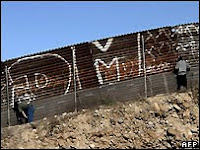
One question that swirls around the recent immigration debate is whether or not a 700-mile wall should be built along the 1,952-mile border w/ Mexico. The House approved $2.2 billion for the wall back in December 2005 to "build a double set of steel walls with floodlights, surveillance cameras and motion detectors along one-third of the U.S.-Mexican border." 1 The Senate approved the bill shortly afterwards.

On Thursday, October 26, 2006, President Bush signed this bill into law. "Unfortunately the United States has not been in complete control of its borders for decades and therefore illegal immigration has been on the rise," Bush said at a signing ceremony. He called the fence bill "an important step in our nation's efforts to secure our borders." 3 (What's interesting to note about the Yahoo article that I found back in 2006 is that it can't even figure out how long the southern border of the U.S. is. One part of the article says it's a "nearly 2,000-mile border" while another part of the article refers to the "fence project covering one-third of the 2,100-mile border." Last time I checked, we haven't changed our southern border with Mexico since the Gadsden Purchase in 1853.)

Since the signing of that bill, the Senate killed President Bush's amnesty bill for illegal aliens in June 2007 which would have gotten an estimated 12 million illegal aliens into the tax system. Apparently, the "American people won today. They care enough to get mad and fight enough for it," said Republican Senator Jim DeMint, though I'm not exactly sure why he'd be mad that MORE people are paying taxes 4. In retrospect, two years later, the country could definitely use that tax money as our federal deficits continue to soar. And I'd ask the senator what the country actually won.

So, what do you think? Does America need this wall? Why or why not? Read the articles on illegal immigration and decide before answering. Check on the links below to read some opinions.

Your answer should be 150 words or more.
Due Tuesday, Sept. 29

1. Article from the San Fransico Chronicle: http://www.sfgate.com/cgi-bin/article.cgi?f=/c/a/2006/02/26/BORDERFENCE.TMP

5. Different views on illegal immigration: http://news.bbc.co.uk/2/hi/americas/4989248.stm

6. An immigrant's story - why she's fighting to stay in America - http://news.bbc.co.uk/2/hi/americas/7346003.stm

7. Divided views as US fence goes up - http://news.bbc.co.uk/2/hi/americas/7212827.stm

Wednesday, October 01, 2008

Blog #3 - Pick a question

Sorry this is late: DUE FRIDAY 10/3/08

Pick one of the following questions and answer it with a minimum of 150 words:


1. Should the estimated 12 million illegal immigrants in the country get a chance at citizenship by learning English, paying fines and work towards citizenship? Why or why not?

2. Should America make English its official language? How about English and Spanish? Think about the consequences for the country and compare it to Canada. For either question, why or why not?

3. Is it important that America maintain the wall along its Mexican border? Or do you think the wall is unfair and a symbol of oppression? Think about the issues brought up in the TIME article (crime, health care, national security, etc.) and tell us what you think.

Thanks.

Friday, January 25, 2008

Blog #4A - Illegal Immigration

A big topic in this election year has been the candidates' stance on illegal immigration. There are an estimated 12 million illegal immigrants in the United States currently w/ approx. 400,000 coming in every year. Most of these folks have arrived as tourists and have overstayed the terms of their visas so they are not the ones that you might envision sneaking across the border in the middle of the night. In order to survive, many of the illegals take jobs that don't require Social Security numbers or they find employers who don't do background checks. Many of these jobs are ones that some Americans don't want. So, these folks are criticized for not paying their taxes. Yet, I wonder, how can they pay their taxes if they're not allowed to have a SS card or #?

So, my questions for you concern the future treatment of illegal immigrants:
1. Should children of illegals be allowed to go to public schools? Why or why not?
2. Should the current illegals that are here now be given the opportunity to become American citizens? Why or why not? If so, under what conditions? If not, what should happen to them?
3. Should prevent future illegal immigrants from coming to America? Do we need to build a wall? Increased border patrols? Or, should we relax our immigration restrictions so that more people can share in the American dream? Why?

Your answer is due Monday, January 28, and should be a minimum of 200 words. Thanks.

Extra credit opportunity: research one of the 8 remaining Presidential candidates (Clinton, Obama, Edwards, McCain, Huckabee, Romney, Ron Paul, and Guiliani) and find out what his/her views are on immigration. Then, summarize those views in 2 paragraphs in your own words. You can email this to me or turn it in by Wednesday, January 30th.
- One suggestion on research - check the candidate's website for accurate information on immigration. If you just type in "Obama + immigration" into a search engine, you're liable to find all kinds of crazy junk out there. Remember, the internet is a tool, but it's also a place where anybody can publish anything.

Sunday, October 22, 2006

Journal #4 - Should America Build a Wall At the Mexican Border?

In our next unit, we will be studying our immigration history, but specifically, we'll look at the time period of 1880s - 1924 when a huge influx of Eastern and Southern European immigrants arrived on our shores looking for work, land, the American Dream and freedom.

One question that swirls around the current immigration debate is whether or not a 700-mile wall should be built along the 1,952-mile border w/ Mexico. The House approved $2.2 billion for the wall back in December 2005 to "build a double set of steel walls with floodlights, surveillance cameras and motion detectors along one-third of the U.S.-Mexican border." 1 The Senate approved the bill shortly afterwards.

On Thursday, October 26, President Bush signed this bill into law. "Unfortunately the United States has not been in complete control of its borders for decades and therefore illegal immigration has been on the rise," Bush said at a signing ceremony. He called the fence bill "an important step in our nation's efforts to secure our borders." 3 (What's interesting to note about this Yahoo article that I quoted from here is that it can't even figure out how long the southern border of the U.S. is. One part of the article says it's a "nearly 2,000-mile border" while another part of the article refers to the "fence project covering one-third of the 2,100-mile border." Last time I checked, we haven't changed our southern border with Mexico since the Gadsden Purchase in 1853.)

So, what do you think? Does America need this wall? Why or why not? Read the articles on illegal immigration and decide before answering. Check on the links below to read some opinions. Your answer should be 150 words or more. Answer by Sunday night 10/29/06, 11:59 p.m.

1. Article from the San Fransico Chronicle: http://www.sfgate.com/cgi-bin/article.cgi?f=/c/a/2006/02/26/BORDERFENCE.TMP

2. Diagram of wall taken from website: http://www.dakotavoice.com/images/fence.jpg

3. http://news.yahoo.com/s/ap/20061026/ap_on_go_pr_wh/bush_immigration_8

Tuesday, September 19, 2006

Photo ID to vote: Good idea or bad idea?

In Congress currently is H.R. 4844, a bill that would require voters to present a photo ID at the polls in order to vote. This quote is taken from http://thomas.loc.gov/.
"To amend the National Voter Registration Act of 1993 to require any individual who desires to register or re-register to vote in an election for Federal office to provide the appropriate State election official with proof that the individual is a citizen of the United States to prevent fraud in Federal elections, and for other purposes."

Pros and cons:
1. Photo ID helps prevent voter fraud.
2. Photo ID is impractical and costly for the elderly and poor.
3. Many people already have this ID - their driver's license - so it will cost little to implement.
4. There's little evidence to suggest that such voter fraud actually exists.
5. Illegal aliens are prevented from voting by such a law.
6. Judges have recently struck down laws like these (or given injunctions to stop them) in states like Missouri http://www.kansascity.com/mld/kansascity/news/politics/15519955.htm, Georgia, Ohio, Indiana, and Arizona.

Read up on it at http://www.salon.com/news/feature/2006/09/15/voterid/index_np.html

So tell us what you think: should Americans have a photo ID to vote in federal elections? Why or why not?