Tuesday, May 27, 2008

Blog #23 - How does Seabiscuit reflect the Great Depression?

After watching clips of Seabiscuit and discovering how much of a hero he and Red Pollard were to America at the time, please explain why so many average Americans were identifying with a sports hero - and one that wasn't even human!

Check out "American Experience: Seabiscuit" and how Charles Howard turned the Biscuit's name into a brand name: http://www.pbs.org/wgbh/amex/seabiscuit/mammalsevents/e_branding.html

The radio calls for Seabiscuit's greatest races: http://www.pbs.org/wgbh/amex/seabiscuit/sfeature/sf_radio.html

Interview with the author, Laura Hillenbrand, who wrote the book that the movie is based upon:
http://www.pbs.org/wgbh/amex/seabiscuit/sfeature/sf_hillenbrand.html


Big Brown, the current Kentucky Derby and Preakness winner, is battling a hoof injury and has taken a few days off before the Belmont Stakes that will be held on June 7th. Big Brown is the 4th horse since 2002 to come close to winning the Triple Crown (having come to Belmont after winning the first two races). You can even buy T-shirts and hats w/ Big Brown on them http://horsehats.com/BigBrown.html .


The Triple Crown of Thoroughbred Racing hasn't been won since Affirmed last did it in 1978. Affirmed also happens to be the great-great-grandson of War Admiral who we saw in the film. Other famous horses include Secretariat (1973 Triple Crown winner) and Seattle Slew (1977 Triple Crown winner and the only undefeated horse to win the TC).
Due Thursday, May 29 - 150 words minimum (in brown in honor of BB).

Friday, May 16, 2008

Blog #22 - Which of the following is the potentially worst economic challenge we face?


We've been studying lots of economic problems facing the country: the national debt, falling dollar, skyrocketing oil prices ($128 a barrel - a new historic high as of Friday). We also looked at Detroit's failure to adapt to the increasing demand for hybrids and higher mileage cars. In addition, we looked at the spread of big box stores like Wal-Mart and Target.

Price pressure on these stores' suppliers have driven many manufacturing jobs overseas in order to keep prices low. In addition, these big stores have forced many smaller stores in the area to close b/c they don't have the purchasing power that a Wal-Mart does. This eliminates smaller businesses - ones in which people have put their hopes and dreams. These companies have also discouraged unions and employed illegal immigrants in pursuit of cost-cutting. Is the creation of these kinds of huge stores just another step in streamlining the dog-eat-dog world of capitalism?

The national debt will be a burden on ourselves and our children if we don't do something about it soon. We can't keep overspending billions and billions of dollars every year. Can we continue to ignore it? Should we raise taxes or cut spending or both? Why? Here's a link to the Treasury Dept.'s frequently asked questions http://www.treasurydirect.gov/govt/resources/faq/faq_publicdebt.htm
The Gross National Debt

Detroit has had a hard time keeping up with the demand for higher mileage cars since they've depended upon the big profits from SUVs. With consumers switching over in a big way to other companies besides the Big 3, what does this mean for Detroit and the state of Michigan?

With fuel prices going up through the roof, inflation has started to kick in a way that we haven't seen since the 1970s - way before you guys were born! Ask yor parents about how much prices went up and the long lines for gas. Just a couple of days ago, Saudi Arabia had agreed to boost its oil production up 300,000 barrels of oil, and Washington said that it would add to the "Strategic Petroleum Reserves" How do we push the country into better energy independence? Is our dependence on foreign oil creating a security nightmare for us because we are stuck in a war in the Middle East?

Which of these issues that we have studied lately do you think will be the worst potential economic problem? Why?
Due Wednesday, May 21-
150 word minimum


Monday, May 05, 2008

The stars of Hippie Day - May 2, 2008

5th Hour (and Jourdan?) flashing the peace sign.


Groovy!

Sweet!


4th Hour hippies! Peace, y'all.


Who knew Tyler was a hippie? I mean, who knew?


2nd Hour hippies!


Is that Ben Wallace, or someone with a 60s style (Abbie Hoffman) fro?

Friday, May 02, 2008

Sheila, the 1974 VW Minibus (Microbus)


Whenever people ride in Sheila, Joe asks that they sign the interior.


Here are some pictures of Joe's bus, Sheila. Many thanks to Joe for putting on his talk today in the pouring rain. Rain didn't stop the hippies at Woodstock, and it didn't stop us now. As Joe said, "everyone has a little hippie in them."

Thursday, May 01, 2008

Blog #21 - Do It Yourself, Part 2

Pick one of the following blogs and give a full, detailed and well-thought out answer. As usual, you can't pick your own, and your answer must be a minimum of 150 words.

1. Do you think that the U.S. would have been any safer w/o fighting the Vietnam War? Was it really worth it? Why or why not? - Lorne, Ben, Ryan B., Bethany, Jourdan, Tyler, Megan W., Jason S.,

2. When public support is so low for a war (Vietnam / Iraq), why did/do we continue to fight that war? - Ally R.

3. With many of the same characteristics as the Vietnam War, do you think that the Iraq War will end the same way or differently? Why? - Christy, Ben, Kelsey, TJ, Robbie L., Alex D., Matt Ba.,

4. Why doesn't the media show us the reality of wars? Should they show us the reality of what's going on in Iraq? - Emily C., Nicole, Michael G., Jessica,

5. How would life (our future) be different today if there was a draft like in Vietnam? Would you enlist, skip out on the draft, or allow yourself to be drafted? Why? - Trevor, Andrew, Claire, Derek M., TJ, Mollie,

6. Do you think it is disloyalty to America if the citizens don't support the troops who are fighting the war? Why or why not? - Raekeshia

7. Do you think the chemical nicknamed Agent Orange was appropriate to use considering the destruction and casualties? Why or why not? - Ian, Fred,

8. Do you think President George H.W. Bush should have gone after Saddam Hussein and his army after freeing Kuwait in 1991? Why or why not? - Rob G., Bethany, TJ, Emma,

9. With over 4,000 soldiers killed and 30,000+ injured from the war in Iraq, besides pulling out the troops, what other solutions are there to stop more Americans from being killed in Iraq? Is there another alternative to pulling out of Iraq? - Angelina

10. If you were on the grand jury in the Kent State shooting case, how would you have voted? Why? - Sarah

11. Given that there are so many similarities between the Vietnam and Iraq wars, why haven't our leaders learned from history? How would you do things differently if you were president? - Sarah, Amber, Jacob T., Jessica,

12. How do you feel about our current foreign policy: do you feel our priorities are out of whack or should we be able to look out for ourselves first? Is there another alternative? - Alexandra, Jacob T.,

13. Should Secretary of Defense Robert McNamara have spoken up sooner about our misguided Vietnam policy than he did? - Paul, Matt Ba., Jessica,

14. Would you have been a protester during the Vietnam War? Why or why not? - Marin, Nikita, Tyler H., Jason S., Megan W.,

15. Do you think the student protests influenced America's decision to leave Vietnam? Why or why not? - Stefan

16. Why didn't more nations support us when we went into the Persian Gulf the second time in 2003? - Stefan

17. Should the American people be able to vote against the President's decisions during war time? Why or why not? - Rob S.,

18. Who was to blame for the Kent State shootings: the National Guard, the students, or someone else? What other ways could this have been handled? - numerous students

19.

Friday, April 25, 2008

Blog #20 - Is it treason to protest a war while it's going on?

During the Vietnam War, student protests played a small but pivotal role in turning public opinion against America's involvement in South Vietnam. Many groups formed to protest the war - groups like the Yippies, The Weather Underground, and Students for a Democratic Society. Yet, 70% of Americans felt that protests in Dec. 1967 were "acts of disloyalty." There's the thinking that the country should rally around the President during war time - no matter what. After the Tet Offensive, opinions on the war turned against it, and so did opinions of the President - both Johnson and Nixon.
In Washington D.C. in November 1969 and and April 1971, over 1/2 million people showed up to protest the war. After the Kent State shootings on May 4, 1970, more average Americans began protesting the war:

"Many labor leaders spoke out for the first time, and blue-collar workers joined antiwar activities in unprecedented numbers. However, construction workers in New York assaulted a group of peaceful student demonstrators, and (with White House assistance) some union leaders organized pro-administration rallies." 2
A recent article from Common Dreams compared the two anti-war movements.

"America's current anti-war movement is resourceful and persistent, but often seems to lack the vibrancy of its counterpart in the Vietnam era when protesters burned draft cards, occupied buildings and even tried to levitate the Pentagon.

A lot of the opposition to Vietnam was motivated by people's fear of going to war - maybe it was pretty self-centered. With this movement, maybe it's not as big, but it comes from a deeper place than 'Hell No, We Won't Go.'

"We're not as unified, not as hard-core, not as big," said Frida Berrigan, 32, a board member of the War Resisters League and daughter of the late peace activist Philip Berrigan. "There's a reason there's not a draft."

"During Vietnam, the perception was that atrocities were everywhere - the military was looked down on," he said. "There is a serious effort now not to stigmatize the military - a conscious effort to say, 'This is not a bunch of baby-killers.'" 1
After the Iraq war began, criticism was somewhat muted, but there were worldwide protests in the hundreds of thousands. By August 2004, almost 500,000 rallied in NYC at the Republican National Convention where President Bush accepted his nomination to run for the presidency again.

Since 2003, there have been sporadic protests, including Michael Moore's infamous blasting of President Bush at the Oscars after winning the award for Bowling for Columbine.
So, what do you think?
Is protesting a war during war time a treasonous offense? Is it an act of disloyalty? Why or why not?
Things to think about: what exactly should be allowed as a protest? Everything? Marches, letters to the editor, sit-ins, etc.? Would you go as far as burning an American flag? What if the draft was reinstated? People were jailed during World War I for speeches (Eugene Debs) and passing out pamplets that called for an end to the war and the draft.
Due Monday, April 28th - minimum of 200 words.
Sources:

Tuesday, April 22, 2008

Colbert Report: What does it take to get John Edwards's vote?


WoW! The election in Pennsylvania hinges on the "white working class" male vote. It's no longer soccer moms or Reagan Democrats. It's the white guy's turn. And here's Senator John Edwards with his take on how Obama or Clinton can get his vote.
Enjoy!

Tuesday, April 15, 2008

Blog #19 - Is the world ready for American democracy?

As we talk about American foreign policy, we've discussed what our goals and guiding principles should be. Our foreign policy goals, as we have collectively discussed in 3 different classes, seem to be:

  1. protect U.S. freedoms at home
  2. improve the quality of life around the world
  3. promote democracy
  4. gain allies
  5. become wealthier as a nation by promoting trade
  6. to maintain our status as the world's superpower.

Today, we discussed how the U.S. might act in situations involving human rights violations (we used China as an example) or genocide (Rwanda, Bosnia, and Darfur come to mind). In addition, many other scenarios could come to mind when thinking about how America should act - how should we treat our allies? Should we honor treaties that we've signed 40 years ago but don't really fit our needs now? What kinds of trade practices should we follow? With these and many other questions, we could fill the rest of the year w/ debate and discussion.

But, right now, I just want to focus on two:

1. Should America's #1 foreign policy goal be to spread democracy around the world? Why or why not? (Think about the assumptions as mentioned in your textbook -pgs. 894-895)

2. Should America be the world's policeman, creating order out of chaos, helping ending conflicts, etc.? Why or why not? Please check these links for a debate about this actual question:

http://www.npr.org/templates/story/story.php?storyId=19180589 - NPR audio file of the debate.

http://www.intelligencesquaredus.org/TranscriptContainer/AmericaWorldPoliceman%20021208.pdf - transcript of the debate.

Answer only one of these questions in a thoughtful paragraph of a minimum 150 words. Your answer is due Wednesday before class.

Thursday, April 10, 2008

Blog #18 - D.I.Y. Blog - Git 'Er Done!

(Before we begin, I must say that I have been highly impressed with the quality of the thinking and the depth of analysis that has gone into the questions. I am especially impressed by the students who I am working w/ for the first time this semester - wrapping your head around these blog questions can be a little tricky sometimes. Well done, and keep up the good work!)

During this Civil Rights and Women's Rights movements unit, we've seen a lot of injustice and been witness to tremendous acts of courage and bravery. I think that there are still many questions left unanswered, so I decided to let you guys ask the questions for a change.

1. Do you think that affirmative action is good or bad for America? - Tyler F., Phil,

2. If Hillary Clinton and Barack Obama were competing for different political parties instead of the same party, who do you think would win the national election for the presidency? Why? - Alyssa T.

3. If you were Fannie Lou Hamer, would you feel that registering to vote was worth all the hassle after? - Derek M., Raekeshia,

4. What if Malcolm X and Dr. Martin Luther King were alive today?

  • How would they react to today's tragedies like Hurricane Katrina?


  • How would the world be different today if they were alive? - Jake C.


  • Which one's tactics/philosophy would you join today? - Kelsey

5. Do you think the things that Senator Obama said in his speech about distractions from the real problems that face America is true or not? Why? - John C.

6. Why do you think someone so unimportant to politics like Bill Russell (or other sports figures in today's world) can have such a big social/cultural impact on America? - Matt Bergin

7. How could the response to Hurricane Katrina have been improved? - Jourdan, Jessica, Jason S., Paul, Carleigh, Ian,

8. Do you think we would be closer to energy independence and newer forms of alternative fuel if if Al Gore had won the election in 2000 instead of George W. Bush? - Tyler H.


9. Which do you think had a bigger impact on the country and why: the Civil Rights or the women's rights movement? - Rob S., Robbie L.,


10.If you were a leader of the Civil Rights Movement back then, would you be a leader more like Dr. King or more like Malcolm X with regard to philosophy and tactics (non-violence vs. by self-defense / convert the opponent vs. black power and nationalism)? Or would you be something completely different? Why? - Stefan, Stefanos, Amber


11. Why is it taking so long to rebuild and repair New Orleans? - Nick


12. How would life be different for women if the E.R.A. amendment had been passed? - Matt Bajorek, Raffi


13. Why did the Bush administration take so long to get down to New Orleans after Katrina? - Ashley D., Alex D., Bethany, Raffi, Ian, Raekeshia, Stefanos,

14. Has women's advancement during the past 40-50 years hurt or helped men? Why? - Nikita

15. Women have always had difficulty with gaining equality and respect from men. So, why would some women dress scantily and only care about their looks to attract men? If women truly wanted to be better, why act dumb and do nothing? - Emma


16. Why do you think women in the 1950s were so dissatisfied with living "the ideal life" as a housewife? - Mollie, Tommy


17. In your opinion, would the appearance of the current female image of "beauty" have changed if pop culture sensation Twiggy not been discovered? Why or why not? - Angelina, Gina


18. Will discrimination ever be over in the future? - Audrey


19. Even though V.P. Al Gore had won the popular vote in the 2000 election, he lost the electoral vote to Governor George Bush. Do you agree that the current voting system we have is o.k. (with the electoral college) or should it be reformed to something else? - Paul


20. Was the non-violent protest method the best way to fight Jim Crow and establish Civil Rights? Why or why not? - Bethany, Sarah, Raffi, Ryan, Marin, Christy, - (It may be easy to judge this in retrospect since it worked, but would a self-defense strategy have worked faster or provoked a more violent reaction from a very racist, resistant South? - the editor)


21. Pretend you didn't know the outcome of the Children's March: would you have taken a stand with the other kids of Birmingham, AL in May of 1963? Why or why not? - Lydia, Angelina, Bethany, Sarah, Kelsey, Ally R., Amber


22. If you were 18 this year, who would you have voted for in each of the primaries and why? - Robert G.


23. If you had lived in New Orleans or in the Gulf Coast region in late August 2005 and Hurricane Katrina was bearing down on the area (pretending you don't know the aftermath, of course), would you have evacuated or stuck it out? Why? Why do you think so many people who could leave stayed? - Sarah


24. Who do you think was the most influential woman in the women's movement? Why? (here's a link to help you with your decision - http://www.legacy98.org/move-hist.html )- Ben, Ally R.


25. Were there parts of Senator Obama's speech of March 2008 that you agreed / disagreed with? Why? - many people asked this question in several different ways.


26. The children of Birmingham, AL marched for freedom. Despite being jailed, their attempts eventually worked, and things became integrated in the South. Many people think that kids can't change history even though here is at least one example that proves them wrong. What would students / teenagers today march for and feel strongly enough to fight for (and maybe even be willing to go to jail in protest)? - Katie B.


27. Do you think you would have urged your state representative to vote for the E.R.A. Amendment back in the 1970s or would you have worked w/ Phyllis Schlafly to defeat the amendment? Why? - Christy


28. How can you try someone for a crime in 2005 that he/she might have committed in 1964 like with the Mississippi Burning case? - Emily C.


29. Why did it take so long for President Kennedy to react to the racism going on in his own country back in the early 1960s? - Lorne


30. How do you think sexual independence has changed women's roles in society today? (Others have asked similar questions about the Pill or Helen Gurley Brown's book, Sex and the Single Girl) - Claire, Tommy


31. What do you think the "proper shape" is for men and women today? - Ryan B.


Pick any one of these questions and answer it fully. You may NOT pick your own blog. Minimum word reply is 200 words.
Due Monday, April 14th, 2008.

Wednesday, April 09, 2008

The Daily Show: Celebrity Endorsements


This is a hilarious look at celebrity endorsements when (it seems) everyone in Hollywood is taking sides in the 2008 Election.

Thursday, April 03, 2008

Blog #17 - Why do you think women have had such a hard time?

Throughout the course of American history, in the land of the free, where "all men are created equal", women have had such a difficult time achieving and maintaining equality. From the time Abagail Adams reminded her husband, John Adams, to include something about women's rights in the Declaration of Independence to Hillary Clinton's Presidential campaign, women have had an uphill road to walk for equality.

Question: Why do you think their (women's) road has been so tough in their fight for equality?

Things to consider: Everyone in America a woman (1/2 the population given the 2000 census) or has been touched by, involved with women in some way or another; with such a close relationship, how can men NOT be influenced to accept women as equals? Is there something built-in to our culture - an anti-woman bias - that keeps women down or degrades them?


Why do you think Hillary Clinton is not succeeding as well as Barack Obama, especially considering that BOTH of them are historical, groundbreaking candidates? Is she losing b/c she's a woman or is she losing b/c of her policies and personality? Lastly, why do groups like Phyllis Schlafly's sabotage women's fight for rights?


200 words minimum.


Due Wednesday, April 9th - Please note new due date. Sorry this was posted so late - have had a busy weekend so far.

Tuesday, April 01, 2008

Extra Credit Blog: William Faulkner Quote

In Senator Obama's speech, he quoted Southern writer William Faulkner who had said this about history:


"The past is not dead. In fact, it's not even past."


When you think of Southern history and all that has passed between blacks and whites over the last 400 years, this quote seems to make more and more sense to me.

As we progress through this Civil Rights unit, tell me what you think the author means by the quote. Think of our history going all the way back to slavery times, the Civil War and Reconstruction, and through the Jim Crow times that Faulkner lived in.

Maximum points: 5
Minimum words: 150
Due by the end of April.

Sunday, March 30, 2008

Blog #16 - Is Fake News Good For America?

Is fake news good for America?

I pose this question for our blog b/c in many ways, though it makes us laugh and it has good reporting, it can also blur the lines between fiction and reality. First, let’s talk about the Daily Show and The Colbert Report.

Jon Stewart joined the Daily Show around 1999 or so and the show became a huge topical news hit when deadpan reporter Steve Carell (the same Steve Carell from 40 Year-Old Virgin, Dan in Real Life and Horton Hears a Hoo) got onto John McCain’s campaign bus called the Straight Talk Express and asked such goofy questions that seemed so real “that McCain didn’t know if [Carell] was joking or serious.” 1

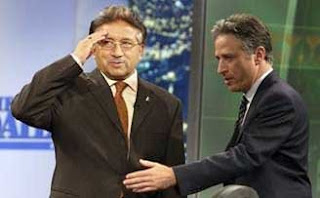
Since then, The Daily Show has become the “pit stop” for politicians looking to get re-elected or people (including politicians) looking to pimp their new books. Even the president of Pakistan, Pervez Musharraf, one of America’s most important allies in the war on terror appeared on the show last year (2007). When politicians appear on the show, they know they might get mocked, yet they play along with Stewart’s schtik anyway.
Appearing on late night shows, a tradition started by a saxophone-playing Bill Clinton on the Arsenio Hall Show in 1992, has tended to result in positive publicity for a politician. Whether it’s Leno, Letterman, Stewart, Colbert or Kimmel, “America wants to see these guys poke fun at themselves…” and “present a hipper, gentler side.” 1


Sometimes, these appearances don’t always go positively or they come too late to matter. In 1996, Senator Bob Dole went on the Late Show w/ David Letterman after he lost the election to Bill Clinton. Dole’s quick wit was such a huge hit that many voters wrote to him wishing that they had voted for him earlier. In the 2004 election, President Bush (“came off horribly wooden”) and Senator John Kerry (who rode a Harley onto Leno’s set) both flopped. 1

But, with all of these politicians playing along with the jokes and even being in on some of the gags, sometimes, a viewer might not know where the reality ends and the satire begins. Jon Stewart’s interviews are sometimes better than the ones that the professionals do. In 2000, The Daily Show won a Peabody Award for its coverage of the Bush / Gore campaign – an award that goes to people in the journalism field. And what about the Colbert Report? Stephen Colbert breaks his wrist and believes that “anything he cares about is important enough to talk about every day.” He wanted people to wear “Wrist-Strong” bracelets for wrist-awareness. 2 How much different is this silliness than Glenn Beck, MSNBC’s pundit, talking about his hemorrhoid surgery and the difficulty he had with it on TV? 3

So when we can’t tell the news from the comedy, when we can’t figure out the truth from fiction, how can we make informed decisions? How can we vote for the right candidates? Does all of this confusion mean that American democracy has become a joke? Or is it that the media isn’t doing its job b/c it is too busy following the government or corporate storyline?

The question: Is fake news good for America? Why or why not? Consider the discussion and the questions above before writing your answer (150 words minimum).
Sources:
1. Peyser, Marc. “Red, White and Funny: The new year will bring a host of intriguing faces front and center. Politicians. Actors. Tycoons. Educators. And one fake news anchor, bravely battling pomposity and misinformation. Jon Stewart prepares for Campaign 2004.” Newsweek. Dec. 29, 2003. P. 70.
2. Weinman, Jaime. “The Secret Agenda of the Colbert Report: in two years, he’s turned a “Daily Show” spin-off into a wacky sitcom.” Maclean’s. Oct. 22, 2007. P. 57.
3. The Drudge Report. http://www.drudge.com/news/102972/glenn-becks-eye-opening-hemorrhoid-surgery . Accessed 3/29/08.

Friday, March 21, 2008

The Daily Show - 5 Years in Iraq


Jon Stewart looks at the administration's underestimation of the length of the war, the terribly lame protest movement, the V.P.'s disregard for American opinion polls, and President Bush's travels back in time.

Thursday, March 20, 2008

Daily Show - Code Pink Tries to Shut Down Marine Recruiting Station


I love this clip by Rob Riggle of the The Daily Show b/c he looks at this inane group called Code Pink (apparently a take-off of the Dept. of Homeland Security's rainbow code system of security) who want to stop the Marines from recruiting in Berkley, California - one of the most liberal places in America. Riggle uses their own comments to show how lame, unfocused and ineffective the anti-war movement is today - he doesn't have to say much, he just uses their own words against them. It's satire at its finest.

Fake News - The Colbert Report


Here is an interview on a "fake news" channel, The Colbert Report, of Samantha Power, the woman we saw in No End in Sight, talking about her new book about Sergio Vieira de Mello, the U.N. fix-it guy that was killed in the truck bomb incident in August 2003. She called him the "most important man we've never heard of."

Wednesday, March 12, 2008

Blog #15 - After September 11, 2001....

Many of you were 9, 10 or 11 years old when this tragic event happened, and that's part of the reason why I feel the need to start the semester with those horrible events of that perfect, blue-sky Tuesday morning in late summer 2001.

In the video we watched together, In Memoriam: New York City: 9/11/01, we saw some awful images - maybe they were new for you, maybe not.

I'd like you to answer a couple of questions:

1. Pretend you don't know anything about what's happened in the six and a half years since 9/11/01 - just pretend. How would you want America to respond to this attack that left 3,000 dead and over 15,000 wounded?

A few things to think about when you answer this question: Would you respond militarily by attacking Al-Qaeda? Would you respond diplomatically by trying to isolate Al-Qaeda economically and help eliminate the sources of poverty? Would you work to improve America's image within the Arab world? Or is there another alternative? What could Americans have done at home to make a difference? (include some of your notes from the video here).


2. Question #2 - Do you believe that the Presidential candidates will be able to do what they say about Iraq? Why or why not?

Alternate question #2 (in case you don't like the first question #2) - Should we remain in Iraq and stabilize the country, withdraw gradually, or leave as quickly as possible? Why?

The Iraq War is now coming up on its 5th year anniversary and few see an end in sight. Click here for the latest opinions on the war from Gallup Poll : http://www.youtube.com/watch?v=zCAaYzFdrm0 (it's very short -only 1:30 long).

So far, almost 4,000 American soldiers have been killed and over 15,000 injured. The war has cost over $3.1 trillion dollars, and America is in the middle of a recession. Gas prices are predicted to hit $4.00 by Memorial Day (a little over 2 months away) and oil prices keep hitting new historic high prices ()$108 a barrel just the other day - 3/11/08). Americans are divided over the war and how to finish the war.

Obama, Clinton and McCain are debating what to do with Iraq and Afghanistan - should I stay or should I go now? Many Americans think that by leaving too early we will leave Iraq as a breeding ground for terror (much like Afghanistan turned into one in the 1990s). Others feel like we need to increase the number of troops. Others feel like that we broke Iraq, we need to fix it.

John McCain: "A greater military commitment now is necessary if we are to achieve long-term success in Iraq. John McCain agrees with retired Army General Jack Keane that there are simply not enough American forces in Iraq. More troops are necessary to clear and hold insurgent strongholds; to provide security for rebuilding local institutions and economies; to halt sectarian violence in Baghdad and disarm Sunni and Shia militias; to dismantle al Qaeda; to train the Iraqi Army; and to embed American personnel in Iraqi police units."
http://www.johnmccain.com/Informing/Issues/

Hillary Clinton: "The most important part of Hillary's plan is the first: to end our military engagement in Iraq's civil war and immediately start bringing our troops home. As president, one of Hillary's first official actions would be to convene the Joint Chiefs of Staff, her Secretary of Defense, and her National Security Council. She would direct them to draw up a clear, viable plan to bring our troops home starting with the first 60 days of her Administration. " http://www.hillaryclinton.com/issues/

Barack Obama: "Obama will immediately begin to remove our troops from Iraq. He will remove one to two combat brigades each month, and have all of our combat brigades out of Iraq within 16 months. Obama will make it clear that we will not build any permanent bases in Iraq. He will keep some troops in Iraq to protect our embassy and diplomats; if al Qaeda attempts to build a base within Iraq, he will keep troops in Iraq or elsewhere in the region to carry out targeted strikes on al Qaeda." http://www.barackobama.com/issues/

Each of your answers to the questions should be a minimum of 100 words.

This song, "Belief", by John Mayer fits this conflict between America and radical Islam so well:

Is there anyone who / Ever remembers changing there mind from
The paint on a sign?

Is there anyone who really recalls / Ever breaking rank at all
For something someone yelled real loud one time

Everyone believes / In how they think it ought to be

Everyone believes / And they're not going easily

Belief is a beautiful armor / But makes for the heaviest sword
Like punching under water / You never can hit who you're trying for

Some need the exhibition / And some have to know they tried
It's the chemical weapon / For the war that's raging on inside

Everyone believes / From emptiness to everything
Everyone believes / And no ones going quietly

We're never gonna win the world
We're never gonna stop the war
We're never gonna beat this
If belief is what we're fighting for

What puts a hundred thousand children in the sand
Belief can / Belief can
What puts the folded flag inside his mother's hand
Belief can / Belief can


I felt that this picture of the parents of Marine Sgt. Robert Courtney, killed by a suicide bomber in Iraq on October 30, 2004, fit the song well("what puts the folded flag inside his mother's hand?"). For every number that we hear on the news... "3 American soldiers killed by a mortar attack in Fallujah..." there is a whole group of people behind that one person who was killed or wounded. This is the human cost of what is being done in Iraq and Afghanistan.

Monday, February 11, 2008

Blog #5A - Is America an Empire?

There have been dozens of books written lately about how America has become an empire - especially with the invasion of Iraq in March 2003. Here's just a sample:


The premise of many of these books is that whether we like it or not, America is an empire. Whether we like acknowledging it or not is whole other thing.


When many people think of empires, we tend to think of the ancient Romans with their gladiators and colisseums, or the British Empire and some guy in a funny-looking pith helmet tromping through the African jungle: "Dr. Livingston, I presume?" With the word "empire" or "imperialism" comes so much negative baggage; plus, those words are so down-right anti-democratic. If we're controlling the destinies of other countries, how are we allowing them to be democratic and free nations?
Being an imperialist nation, apparently, has been something we've been working at for several decades now. A book by Stephen Kinzer called Overthrow outlines over a dozen instances where the United States has taken control of a country b/c our business or political interests were threatened, resources were slipping out of control, or during the Cold War, we felt the creep of socialism get too close.
We've talked about how widespread American military is across the world: 700 military bases in 60 countries; 1.4 million soldiers. There's an upside to all of this - don't get me wrong! Because of these brave men and women, we're so much safer than we would be without them. I am grateful for theirs and their families' sacrifices.

The question to answer: Is America an empire?
Questions to consider but not necessarily answer - is the course we've taken towards building an empire worth the hatred of the world? Our safety doesn't mean much when terrorists want to kill us at home. Morally, are we doing the right thing by keeping other countries from determining their own destiny? Economically, is the tax money we're spending on our military also the right thing to do? Should the other countries of the world shoulder their own defense expense? Why or why not?
Minimum response - 250 words - due Wednesday - 2.13.08
Find out how we overthrew Iran in 1953: A Folly of Attacking Iran: Lessons from History - http://www.youtube.com/watch?v=AJRcOF7rEfQ

Journal #13B - 40 different ways to look at JFK

After reading and listening to the different views of President Kennedy's life as seen through different biographers' eyes, it's time for your opinion/assessment.

John Kennedy's biographers are usually broken into two groups: one group works to reinforce the image of Kennedy as icon, as the ideal president. They tend to gloss over the difficult stuff in his life with the idea that it's not important to know that kind of info about him. These biographers also stress his good qualities and downplay his bad qualities.

The second group of biographers are iconoclasts; they are trying to poke holes in the JFK myth by finding evidence to refute many of the cherished (and false) stories about the Kennedy family, clan, and presidency. These biographers are like realist authors - they give you the gritty details of a person's life; the fact that this person was the president doesn't seem to phase them.

The American people have consistently voted JFK (along with Lincoln) as their greatest American President, yet historians have given him the title "Most Overrated" in American Heritage magazine. When looking at his Congressional record, he didn't do much. Almost the same thing can be said for his Presidential record; how significant were the Peace Corps and the race to the moon in the long run?

Your job: answer the following questions:
1. Share your assessment of the man and his job as president by looking back at your notes on the 8 sections of the book. Explain your reasoning with specific examples.
2. Where should biographers draw the line on their subjects? How much is too much and how little is too little?It really boils down to what the main job of a biographer is.

250 words minimum. -Due Wednesday - 2/13/08

http://www.maryferrell.org/wiki/index.php/Main_Page - Great link to a tribute website to a JFK archivist, Mary Ferrell.

Thursday, January 31, 2008

Blog #12B - Good Night and Good Luck

Choose three statements – one from each speech – and discuss how each statement can be applied to our world and political or social situations today.

" No one familiar with the history of this country can deny that congressional committees are useful. It is necessary to investigate before legislating, but the line between investigating and persecuting is a very fine one and the junior Senator from Wisconsin has stepped over it repeatedly. His primary achievement has been in confusing the public mind, as between the internal and the external threats of Communism. We must not confuse dissent with disloyalty. We must remember always that accusation is not proof and that conviction depends upon evidence and due process of law. We will not walk in fear, one of another. We will not be driven by fear into an age of unreason, if we dig deep in our history and our doctrine; and remember that we are not descended from fearful men. Not from men who feared to write, to speak, to associate, and to defend causes that were for the moment unpopular.

This is no time for men who oppose Senator McCarthy's methods to keep silent, or for those who approve. We can deny our heritage and our history, but we cannot escape responsibility for the result. There is no way for a citizen of a republic to abdicate his responsibilities. As a nation we have come into our full inheritance at a tender age. We proclaim ourselves, as indeed we are, the defenders of freedom, wherever it continues to exist in the world, but we cannot defend freedom abroad by deserting it at home. The actions of the junior Senator from Wisconsin have caused alarm and dismay amongst our allies abroad, and given considerable comfort to our enemies. And whose fault is that? Not really his. He didn't create this situation of fear; he merely exploited it — and rather successfully. Cassius was right. "The fault, dear Brutus, is not in our stars, but in ourselves." Good night, and good luck."
– See it Now broadcast, March 9 1954

If we confuse dissent with disloyalty — if we deny the right of the individual to be wrong, unpopular, eccentric or unorthodox — if we deny the essence of racial equality then hundreds of millions in Asia and Africa who are shopping about for a new allegiance will conclude that we are concerned to defend a myth and our present privileged status. Every act that denies or limits the freedom of the individual in this country costs us the . . . confidence of men and women who aspire to that freedom and independence of which we speak and for which our ancestors fought."
– Ford Fiftieth Anniversary Show, CBS and NBC, June 1953

“We are currently wealthy, fat, comfortable and complacent. We have currently a built-in allergy to unpleasant or disturbing information. Our mass media reflect this. But unless we get up off our fat surpluses and recognize that television in the main is being used to distract, delude, amuse and insulate us, then television and those who finance it, those who look at it and those who work at it, may see a totally different picture too late.

Our history will be what we make it. And if there are any historians about fifty or a hundred years from now, and there should be preserved the kinescopes for one week of all three networks, they will there find recorded in black and white, or color, evidence of decadence, escapism and insulation from the realities of the world in which we live. I invite your attention to the television schedules of all networks between the hours of 8 and 11 p.m., Eastern Time. Here you will find only fleeting and spasmodic reference to the fact that this nation is in mortal danger. There are, it is true, occasional informative programs presented in that intellectual ghetto on Sunday afternoons. But during the daily peak viewing periods, television in the main insulates us from the realities of the world in which we live. If this state of affairs continues, we may alter an advertising slogan to read: LOOK NOW, PAY LATER.

For surely we shall pay for using this most powerful instrument of communication to insulate the citizenry from the hard and demanding realities which must be faced if we are to survive. I mean the word survive literally. If there were to be a competition in indifference, or perhaps in insulation from reality, then Nero and his fiddle, Chamberlain and his umbrella, could not find a place on an early afternoon sustaining show. If Hollywood were to run out of Indians, the program schedules would be mangled beyond all recognition. Then some courageous soul with a small budget might be able to do a documentary telling what, in fact, we have done--and are still doing--to the Indians in this country. But that would be unpleasant. And we must at all costs shield the sensitive citizens from anything that is unpleasant.

I am entirely persuaded that the American public is more reasonable, restrained and more mature than most of our industry's program planners believe. Their fear of controversy is not warranted by the evidence. I have reason to know, as do many of you, that when the evidence on a controversial subject is fairly and calmly presented, the public recognizes it for what it is--an effort to illuminate rather than to agitate.

I do not advocate that we turn television into a 27-inch wailing wall, where longhairs constantly moan about the state of our culture and our defense. But I would just like to see it reflect occasionally the hard, unyielding realities of the world in which we live. I would like to see it done inside the existing framework, and I would like to see the doing of it redound to the credit of those who finance and program it. Measure the results by Nielsen, Trendex or Silex-it doesn't matter. The main thing is to try. The responsibility can be easily placed, in spite of all the mouthings about giving the public what it wants. It rests on big business, and on big television, and it rests at the top. Responsibility is not something that can be assigned or delegated. And it promises its own reward: good business and good television.

To those who say people wouldn't look; they wouldn't be interested; they're too complacent, indifferent and insulated, I can only reply: There is, in one reporter's opinion, considerable evidence against that contention. But even if they are right, what have they got to lose? Because if they are right, and this instrument is good for nothing but to entertain, amuse and insulate, then the tube is flickering now and we will soon see that the whole struggle is lost.

This instrument can teach, it can illuminate; yes, and it can even inspire. But it can do so only to the extent that humans are determined to use it to those ends. Otherwise it is merely wires and lights in a box. There is a great and perhaps decisive battle to be fought against ignorance, intolerance and indifference. This weapon of television could be useful.

Speech at Radio-Television News Directors Association, Chicago, October 15, 1958.