Showing posts with label World War 2. Show all posts

Friday, December 14, 2018

Blog #45 - Drop the atomic bomb? Yes or no?

Time: August 1, 1945

Your job: An advisor to President Truman.

The issues:
1. What is the best way to get Japan to surrender without invading?
2. Should we use the atomic bomb to force Japan to surrender?  If so, how should it be used?
3. Do we go ahead with the invasion of Japan (overall known as Operation Downfall)? see link for info on Downfall.  https://en.wikipedia.org/wiki/Operation_Downfall

Scenario: 
America has fought defeated Germany already, getting them to surrender earlier this year in May and Japan is the lone target for all of the Allies. 

The Soviet Union has planned to attack Japanese troops in northern China soon, and you are worried about the Soviets' influence in both Asia and Europe after World War 2.  They have already begun installing Communist governments in Eastern Europe, in defiance of the Yalta Peace Conference agreement. 

Secretary of State James Byrnes feels that using the atomic bomb will send a signal to the Soviets to stop expanding, yet America needs their help to defeat the Japanese in China.  America has been given the sole task of invading the mainland islands of Japan. 

Another thing to consider is that Japan currently holds tens of thousands of Allied prisoners of war around Asia.  What would happen to them if an invasion of Japan occurred?  Would they all be massacred by the soldiers watching them? 

One more thing to consider is Admiral Leahy's recommendation: Don't use the bomb but stop all shipping to the island, essentially quarantine Japan, and wait them out until they surrender.  The Japanese may not surrender until they know that their emperor is safe because they see him as a god on Earth. 

Intelligence sources are picking up information that some Japanese officials have contacted the Soviet Union about possible surrender, but nothing official has been announced.  The Soviets may or may not cooperate with us in reaching a surrender agreement. 

As of now, Operation Olympic (phase 1 of Downfall) is planned for the invasion to take place on November 1 later this year.  Because of the heavy defenses on the mainland of Kyushu, the Army Chief of Staff is predicting 450,000 casualties, including 100,000 dead just within 90 days.  That total is significantly greater than any single battle we have ever seen in American history. 
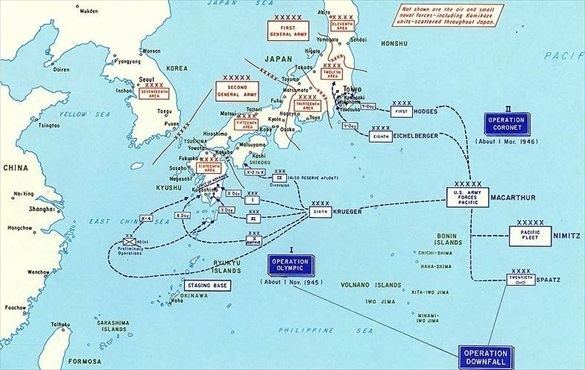
Related image

In order for Operation Downfall to work, Olympic must be successful, so that we can launch Operation Coronet (phase 2 of Downfall) in March 1946 which would invade the main island of Honshu close to Tokyo. 

We have to consider the possibility that the Japanese may not surrender after dropping the two atomic bombs and that we will have to go through with Operation Downfall.  The big question is, the Japanese are weary of war as we are, especially since they've been fighting it since 1937, so would they surrender after being hit with the most destructive bomb in the history of mankind? 

In your response (answer #1 and #2 or #3), 
1. Consider the options listed above - which options seem most likely to get the Japanese to surrender? Why?
2. If you recommend that President Truman use the bomb(s), how do we use it?  What is your rationale? 
3. If you recommend that President Truman go ahead with the invasion, what would be the impact on America from such horrific casualties? 

300 words minimum.  Due Monday, December 17th by class.  

Saturday, March 27, 2010

Blog #27 - Fascism Can't Happen Here, Can It?

Could something like Japan, Germany and Italy's descent into fascism happen in America today?
If you remember the circumstances when these three countries fell under fascism's spell, the following was happening in these 3 countries:


1. A major economic depression (1929-1933) put amazing stress upon these three countries' economic systems, causing massive unemployment, inflation, and extreme stress upon their banking systems;


2. Weak democracies were unable to meet the demands upon its organization, whether through the rising violence in the streets, the internal threats from revolutions on both the left (Communists and Socialists) and the right (fascists), or the overwhelming poverty of the Depression or other economic crises (like Germany's hyperinflation crisis of 1922-23);


3. Strong nationalist feelings helped make the people in their country ready for a leader (Hitler, Mussolini, Hirohito) who would exploit the country for his own personal sake;


4. In each country, a strong military presence - either with generals taking over the gov't. in Japan or the rebuilding of Germany's industry through an increase in military forces or the desire to spread out for resources and recapture old glory like Italy - allowed each country to channel their aggression and spread their imperialist demands;


5. In each country, the conservative business interests sided with the fascists in the hopes of postponing or preventing a socialist or communist revolution like what had occurred in Russia.  That was the greatest fear and these industrialists would rather ally themselves w/ a devil who is on their side (who they also thought they could control) then risk free elections.  What you end up seeing are corporations receiving favoritism or outright support over the working class of a nation. 


6. Free elections became tampered with or voters were intimidated at the polls before they stopped altogether or just gave up the pretense of being free and open (hmmm.... should I vote for this Nazi or that Nazi?).  So, whether the elections are national, state or local, they have been tampered with through stuffed ballots or detroyed or lost votes or large numbers of opposition voters being kept from voting;


7. Create an internal threat that could scare the country and allow the government greater powers to pursue this threat.  When the Reichstag (Germany's legislature) was burned down, the Communists were blamed and Hitler gained more power to pursue enemies of the state.  Two years later, Jews legally lost their rights.  It ends up that these internal enemies can become scapegoats for the problems that the nation encounters. 


Your questions:
1. Could these things occur in America? Why or why not?
2. Where do you see similar already occuring in America right now? Explain w/ examples. 


200 words minimum (not per question but total). Due Tuesday, March 30
(I gave you an extra day to do this b/c I didn't post this until Saturday afternoon). 


Author Sinclair Lewis wrote about this exact scenario in his novel in It Can't Happen Here in 1935.
 
http://gutenberg.net.au/ebooks03/0301001h.html
Here's a link to the novel online.

Monday, June 01, 2009

Blog #16 - Just War - WW2, Vietnam, Iraq

When we think of war, historians make a distinction between just and unjust wars. Just wars are fought by countries who hold true to principles whereas unjust wars are fought either by nations or groups w/o principles and are fought for immoral gains. This concept is as old as the Roman Empire and its great poet, Cicero, but has been also developed more thoroughly by the Catholic Church and its saints Augustine and Thomas Aquinas.


The principles of a just war include jus ad bellum, the right to go to war, and jus in bello, right conduct in war. You will see these principles fleshed out in some of the following bullets below:
  • A just war can only be waged as a last resort. All non-violent options must be exhausted before the use of force can be justified.
  • A war is just only if it is waged by a legitimate authority. Even just causes cannot be served by actions taken by individuals or groups who do not constitute an authority sanctioned by whatever the society and outsiders to the society deem legitimate.
  • A just war can only be fought to redress a wrong suffered. For example, self-defense against an armed attack is always considered to be a just cause (although the justice of the cause is not sufficient--see point #4). Further, a just war can only be fought with "right" intentions: the only permissible objective of a just war is to redress the injury.
  • A war can only be just if it is fought with a reasonable chance of success. Deaths and injury incurred in a hopeless cause are not morally justifiable.
  • The ultimate goal of a just war is to re-establish peace. More specifically, the peace established after the war must be preferable to the peace that would have prevailed if the war had not been fought.
  • The violence used in the war must be proportional to the injury suffered. States are prohibited from using force not necessary to attain the limited objective of addressing the injury suffered.
  • The weapons used in war must discriminate between combatants and non-combatants. Civilians are never permissible targets of war, and every effort must be taken to avoid killing civilians. The deaths of civilians are justified only if they are unavoidable victims of a deliberate attack on a military target. (http://www.mtholyoke.edu/acad/intrel/pol116/justwar.htm)

Using the criteria above, consider what you've read (and check out at least one of the links below to include in your response), tell me the following:


1. Was World War 2 a Just War? Why or why not? If it's not tell me where it fails by your criteria.

2. Was Vietnam a Just War? Why or why not? And finally, has Iraq and the rest of the War on Terror been a Just War? Why or why not?

Due Wednesday, June 3 - 250 words minimum. (20 points)

Go Wings!

Thoughts to consider:

NPR's analysis of Just War Doctrine only 4 months after the 9/11 terrorist attacks - http://www.npr.org/programs/morning/features/2002/jan/justwar/020125.justwar.html

Iraq a Just War from an Australian newspaper - http://www.theaustralian.news.com.au/story/0,25197,25571560-7583,00.html

Just War Theory (Internet Encyclopedia of Philosophy) - http://www.iep.utm.edu/j/justwar.htm

The Nation's take on Just War after the Afghanistan War began - http://www.thenation.com/doc/20011029/falk - "The war in Afghanistan against apocalyptic terrorism qualifies in my understanding as the first truly just war since World War II."

A great compendium on JustWar Theory info by the BBC -http://www.bbc.co.uk/ethics/war/index.shtml

Friday, May 15, 2009

Blog #15 - Do It Yourself - Pick a question and answer it!

All right. I know that you've been dying to ask some blog questions all semester long, and here are some of your fellow classmates' best inquiries into our subject matter.

Pick one and do your best to answer one of these questions that is NOT a who, what, where, or when question. These questions are more of why, how, what if types of questions. Dig deep into the personalities we've studied, try to find the issues that have bothered you or that have been sticking in your head "like a splinter in your mind."

Pick one and answer it with a minimum of 200 words. Due Monday, May 18.

1. If you lived in the 1970's what would be your reaction to when Nixon says 'If the president does it, its not illegal."? (brandon k.)

2. If America chose not to get involved in world crisis', what do you think the world would look like and why? (brandon k.)

3. During Watergate, Nixon invoked his power of executive privilege regarding his secret tapes. To what extent should a president be allowed to maintain privacy in the Oval Office? Why do you think this? (melanie e.)

4. Has our government made the right decisions in supplying energy needs to the U.S. and is our current administration directions on the right path? Why or why not? (melanie e.)


5. Was Nixon’s presidency overall considered beneficial or was it not? (Keeping in mind the Watergate scandal, the pentagon papers, giving false information to the American people, the policy on Vietnam, invasion of Cambodia etc)can his personality be judged by these incidences or it was just the power that he had making him do this? (gauri)


6. Did the policemen act in the correct or proper manner outside the convention hall in Chicago and was it justified? Was it all right for the policemen to be that harsh to the protesters who were kids? The Americans said that the guards were partially correct in what they did. How would you have reacted to this incident? (gauri, china w., )

7. If you were president and your men had perpetrated the Watergate burglary, how would you have handled it? When the news about Watergate finally surfaced, how would you have dealt with that news? (allison w.)

8. How do you think we would have dealt with the Iraq War/Conflict after the 9/11/01 terror attacks if we would have killed Saddam during the 1st Gulf War in 1991? Do you think there would have even been a second war in 2003? Explain. (johanna)

9. Considering how far America has come in the pursuit of guaranteeing civil rights today, what else do we have to further the goals of Dr. King? (sydney h.)

10. Do you think the way America is portrayed as a "free country" is accurate to how it really is? (katie r.)

11. Why has the hippie subculture become so ridiculed in today's society? (jack d.)

12. Why do you think we can't find Osama Bin Laden? Have the U.S. soldiers been trying hard enough to find him? Or has the information they've been getting so poor or bad that they can't find him? (sam s., mary s.)

13.If Michigan experienced a catastrophic natural weather event on the scale like Hurricane Katrina, do you think you and your family would stay and rebuild your life here or would your family move to another state? (sam s.)


14. Where do you think the world would be if not for Dr. Martin Luther King, how would life be different today? (alana w.)

15. How the world be different if the 9/11/01 attacks hadn't happened? Would security at airports and sporting events be as strict as it is today? Would we have gone into Iraq and Afghanistan as well? (mike m.)

16. Should the U.S. not allow foreign car makers like Honda, Isuzu and Volkswagen to sell their cars here in America? Why or why not? (thurgood)

17. What did you get out of the Frost - Nixon interviews? What do you think of Richard Nixon as a person and a president? (tyler p.)

18. How will Americans look at the Middle East after the Iraq War is over? How will Middle Easterners see America after the war? (kevin l.)

19. Do you think the U.S. government was involved in the 9/11/01 attacks? If so why? (danielle m.)

20. Who do you think did a better job handling Iraq and Saddam Hussein: George H.W. Bush (41) or George W. Bush (43)? (allison s.)

21. A lot of people seem to be overreacting about the taped recordings Nixon had of White House conversations. Do you think people made too big of a deal out of them when they learned about them in 1973 and it should have been o.k. for the president to do what he liked with them? Or do you think it was a big deal that Nixon wanted to keep the tapes? (bobby h.)

22. If there is another terrorist attack, will America (and America's government) be ready this time? Why or why not? (jacob s.)

23. What will Americans do if President Obama isn't as good as he s believed to be? (jacob s.)

24. Was splitting Germany in 2 parts the right thing to do after WW2 considering all of the problems of the Cold War? (china w.)

25. Do you think the Supreme Court was right in overruling Nixon's executive privilege argument about the WH tapes? Why or why not? (andrew s.)

26. Do you think President Reagan came up with SDI for the protection of America or was there another reason? Why? (ryan s.)

27. In your opinion, should Nixon have ever been put in prison? Why or why not? Or was pardoning him the right thing to do? (tyler d.)

28. If you were president during the Vietnam War, what would you have done differently than presidents Kennedy, Johnson and Nixon? (matt t.)

29. If you were in Rosa Parks' shoes, what would you have done? (evan f.)

30. Which has been more devastating for the United States: Vietnam or Iraq? Why? (kyle d.)

31. When do you think the war on terror will end? Why? (kyle d.)

32. Should President George H.W. Bush (41) gone into Baghdad when he had the chance back in 1991 and killed Hussein when he had the chance? Why or why not? Do you think that would have solved things that we're seeing in Iraq today or would we still be there? (tim t.)

33. In the movie, Frost/Nixon, why do you think Nixon seemed so unprepared or out of it in the final Watergate interview? (eric b.)

Due Monday, May 18.

Sunday, January 06, 2008

Blog #9B - Would you fight if drafted?

As the American military has been stretched thinner and thinner by our commitments in Afghanistan and Iraq in the past six years plus the falling retention rate of soldiers, talk of reinstating a draft has continued to come up. This talk of a draft is like that dandelion in your yard that just won't go away.

In 2003, on the eve of war with Iraq, a bill was introduced in Congress that called for reinstating the draft but with much fairer provisions than the one that was ended in the mid 1970s used to fight the Vietnam War. Back then, the poor and minorities were drafted much more often than wealthy white males who had connections and could use them to get out of the draft (Bill Clinton), or get nice national guard duty (George W. Bush, former V.P. Dan Quayle), or get medical deferments (Dick Cheney). Many other wealthy people got to use college deferments as a way to get out of the draft.

This new bill introduced in 2003 would supposedly eliminate all of these deferments and make it harder for American citizens to move to and live in Canada to evade the draft. The bill called for 2 years of service to the American government for both men and women between the ages of 18-26. The bill sat in committee for over a year and a half and then was finally voted down overwhelmingly (402-2 in the House on HR 163) a month before the 2004 election. Gee, what a surprise!
During the time period we're studying, World War 2, the U.S. also needed a draft to supply the soldiers to fight fascism. According to our textbook, 5 million men volunteered for the war, and the draft was expanded to include another 10 million.
Currently, there is no draft. According to this CBS News article that I found, http://www.cbsnews.com/stories/2006/12/22/national/main2291979.shtml, sometime in the near future (before 2009 - the story was published Dec. 22, 2006) the government will test the Selective Service System which hasn't been tested since 1998. But, as evidenced by General Lute's testimony here, some people still think it's a good idea.
So, my questions for you are:

1. If drafted when you're old enough to fight in the war on terror, would you fight? Why or why not? Would it depend on the situation or is it important that you answer the call when your country needs you? Why?

2. If you had lived during World War 2 times and the Japanese had just bombed Pearl Harbor (and you're of draft age), BOYS - would you have volunteered or waited to have been drafted? Explain your answer.

GIRLS - Would you have supported your father's/brother's/ boyfriend's/husband's choice to volunteer for the war or would you have encouraged him to wait? Why?

(100 words minimum for each question - 1 and 2 - is fine).

Before you answer, you may want to read this pro/con piece from a couple of veterans at Georgia Tech University. http://www.cc.gatech.edu/~tpilsch/History/Reinstate.html Both of them bring up some very valid points for and against a draft.

Sources:
1. June 2007, Bush War Advisor Says Draft Worth A Look. http://www.commondreams.org/archive/2007/08/11/3117/
2. Dec. 22, 2006, Military Draft System to be Tested.

Thursday, March 08, 2007

Nagging questions about World War 2

We've finished our unit on World War 2 but that doesn't mean that we've answered all of the questions out there. After the test this week, you guys came up with some very interesting thoughts and questions that showed some deeper thinking. Here are some of the best questions (you're responsible for answering at least one by Pie Day 3/14 Wednesday at 11:30 a.m.):

1. What happened in Detroit in 1943 that created all the tension for the race riot? - Shayna

2. To what degree did Hitler's service in World War I influence his later politics? - Martin

3. Holocaust deniers claim that the Holocaust never occurred, yet how can they deny it with so much visual, actual proof? - Martin

4. I know that the U.S. had a great military back during the war, but it's hard for me to understand how in some of the battles there was such a huge difference in the number of casualties. For instance, at Iwo Jima, 6,000 Americans vs. 20,500 Japanese. Okinawa was much worse: 12,600 (7,600 soldiers + 5,000 sailors) Americans vs. 110,000 Japanese. What do you think accounts for the difference in the numbers? - Colleen

5. According to the textbooks, we saw Stalin as an ally during the war but he was responsible for killing more of his own people than Hitler. Everyone knows about Hitler and the Holocaust but we hear little about Stalin and these deaths. Why is that? - Allison and Colleen

6. Since there were so many more Jews in the concentration camps than Nazis, why didn't they try to band together and fight back? - Shayla, Andy R.

7. In every war there are P.O.W.s. Did the United States have any enemy P.O.W.s during WW2 like we do now with the Iraq War at Guantanamo Bay? Do you think we treated them as badly?
- Alex S.

8. What if the U.S. didn't enter the war, how would the U.S./the world be different today? - Ashley, Jill, Lori, Kaitlyn,

9. Do you think that Oppenheimer and those other scientists really thought that they were "saving lives" when they built the atomic bomb? - Alex L.

10. Why would anyone be a kamikaze pilot? What must it be like? Did his family receive anything in return? - Ryan, Crystal, Ciara, Andrew W., Larry, Brittany, Adam

11. Have we really learned from the Holocaust when we look at Rwanda and Darfur? - Crystal

12. How would you have survived the concentration camps? Would you have struggled on and lived through the horror or would you have rather died and been spared the agony? - Megan

13. What made Hitler the way he was? How did he become so popular and influential? - Hannah, Larry, Erin, Samantha, Adam, Ryan, Jasmine, Imani, Shayna, Martin, Claire, Trevor, Leah, Shayla,

14. How are relations between the U.S. and Japan today? Do the atomic bombs play any role in these relations? - Alice

15. Where was Superman during all this time? - Thomas


Editor's Note: I think I found the answer, Thomas. Unfortunately, the action in the comics never matched reality.


Detroit News account of 1943 race riot: http://info.detnews.com/history/story/index.cfm?id=185&category=events


Also, I've checked Ebay and ration books are selling for between $1 and $10 if you're interested in having your own set.


When looking for info on Hitler, take care to make sure your source is very credible. Like with most historical figures, legends have been repeated so often that they have become fact. That makes it difficult to find accurate info.

Please post just your first name and last initial.

Thursday, February 08, 2007

Journal #3 - Will the past ever leave us alone?

William Faulkner, a great American writer of the first half of the 20th Century wrote:
"The past is never dead. It's not even past."

I got to thinking about this quote as we're coming up to our unit on World War II and all of the awful things that happened during that war. The death toll is staggering. An estimated 62 million people were killed, 37 million civilians and 25 millions soldiers. There were crimes against humanity - the Holocaust visited upon Europe's Jews and other outsiders; 7 million Chinese civilians killed not only by the Japanese but also in a bloody civil war; and Allied soldiers brutally kept in Japanese prisoner-of-war camps in Asia.

It has been over 60 years since this war ended, yet we still see reminders of this war in many places that we go.
1. The United Nations Security Council is based upon the winners of the war and hasn't changed to reflect the world as it is today;

2. Japan has little to no armed forces;

3. Germany still pays reparations to the survivors of the Holocaust;

4. A distrust between the Soviet Union and America during the war carried over into a 46 year Cold War which we will continue to pay for until many of us are old and gray;

5. The cloud of Japanese internment camps hangs over America as a gross violation of Japanese-Americans civil liberties;

6. And we all live under the specter of a nuclear blast because of the race for the atom bomb in the 1940s that America won in July 1945 when we detonated one successfully in Trinity, New Mexico. One of the biggest threats to world peace, if not the biggest threats, is the spread of nuclear weapons.

So, my questions for you, as we approach World War 2, are:

1. What should our approach to the war be? Do we look at it just as another American war which expanded our military, economic and political power across the globe? Or was there a greater purpose involved in fighting the war?

2. When do we let go of the legacy of the past? When is enough enough? Or are there some things that should never ever be forgotten? Specifics would be great for this answer
(150 word minimum, please).