Showing posts with label national debt. Show all posts

Monday, October 15, 2018

Blog #44 - Flat tax or Progressive Tax

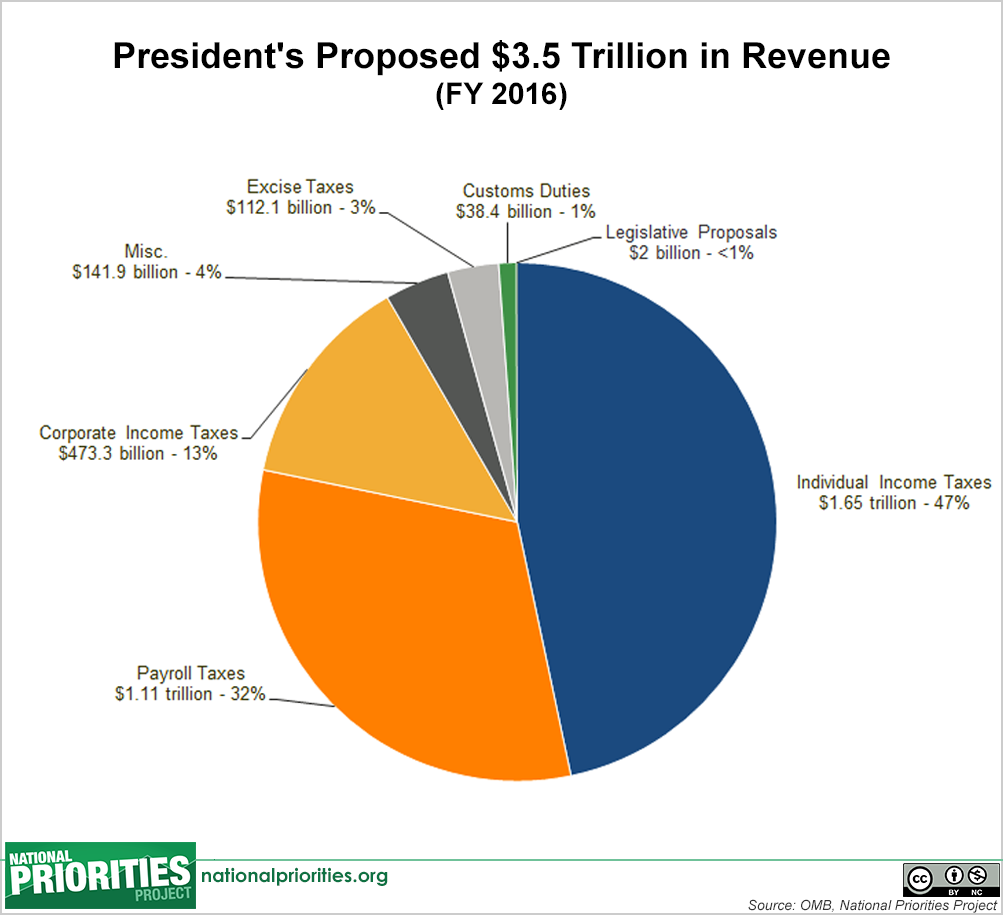
During this week, we discussed the 16th Amendment and the income tax - its fairness and unfairness. Its opponents have proposed a flat tax that everyone pays the same rate across the board: 20%. That way, if you earn more, you technically pay more. So, in some ways it sounds progressive. If you see the chart below, this is where almost all of our tax income comes from: 
Image result for chart of U.S. government spending  The biggest portion comes (47%) comes from income taxes.  Another portion comes from payroll taxes (32%) and then corporate taxes are the third biggest chunk (13%) as of fiscal year 2016.  

The argument for the flat tax focuses on several arguments:
1. It eliminates special- interests by treating all taxpayers equally. Taxpayers will no longer be able to "scam the system by hiring enough lawyers, accountants and lobbyists."
2. It will boost economic growth by allowing businesses and investors to invest more money (saved by not giving as much money in taxes) into other businesses and ventures.
3. It eliminates the capital gains tax, the estate tax (other people call it the "death tax"), and double taxes on savings (taxed once when you earn it and it's deposited into the bank and then twice at the end of the year as part of your income though it already is in your bank account).
4. It's amazingly simple. Household income tax forms are now done on a postcard. It also treats all businesses the same: "Microsoft to a hot dog stand would play by the same rules."

Arguments for the progressive tax include:
1. All Americans benefit from two of our government's responsibilities, protection (police, firefighters, public health, military) and empowerment (roads, public education, banking system for loans and economic stability, SEC for the stock market, courts, national parks, public buildings, etc.), and they should be available to everyone. We are financially responsible to maintain these so that they may be used for the common good. These protections are maintained through taxes.
2. The wealthy (corporations, investors and other wealthy individuals) pay more into the system because "our taxes create and sustain, [and] empower the wealthy in myriad ways to create (and sustain) their wealth." In other words, they have benefited from the system in place, they should pay to maintain it.

"Consider Bill Gates...Though he has undoubtedly benefited from his unusual
intelligence and business acumen, he could not have created or sustained his
personal wealth without the common wealth [of the United States]. The legal
system protected Microsoft's intellectual property and contracts. The
tax-supported financial infrastructure (phones, electricity, Internet) enabled
him to access capital markets and trade his stock in a market in which investors
have confidence. He built his company with many employees educated in public
schools and universities. Tax-funded research helped develop computer science
and the internet..." and so on.


3. The wealthy are morally obligated to sustain the American system b/c they benefit more from it than the average American. "Ordinary people rarely use the courts; most of the courts are used for corporate law and contract disputes." Therefore, the rich pay more than the poor or middle class b/c the rich utilize the system more often to create and sustain their wealth.  Their wealth is protected from useless lawsuits in courts and by laws.  

So, I think we have two very persuasive arguments here, but I think we're missing the real questions that we should be asking. The questions we should be asking are: 
1. What are we spending our money on? 
2. Why are we spending so much of our money instead of letting the American people spend it? 
3. Why do we have such a huge national debt? 
4. What can we do about it? 

If you see the chart below, the U.S. federal government spend almost 4 trillion dollars a year:
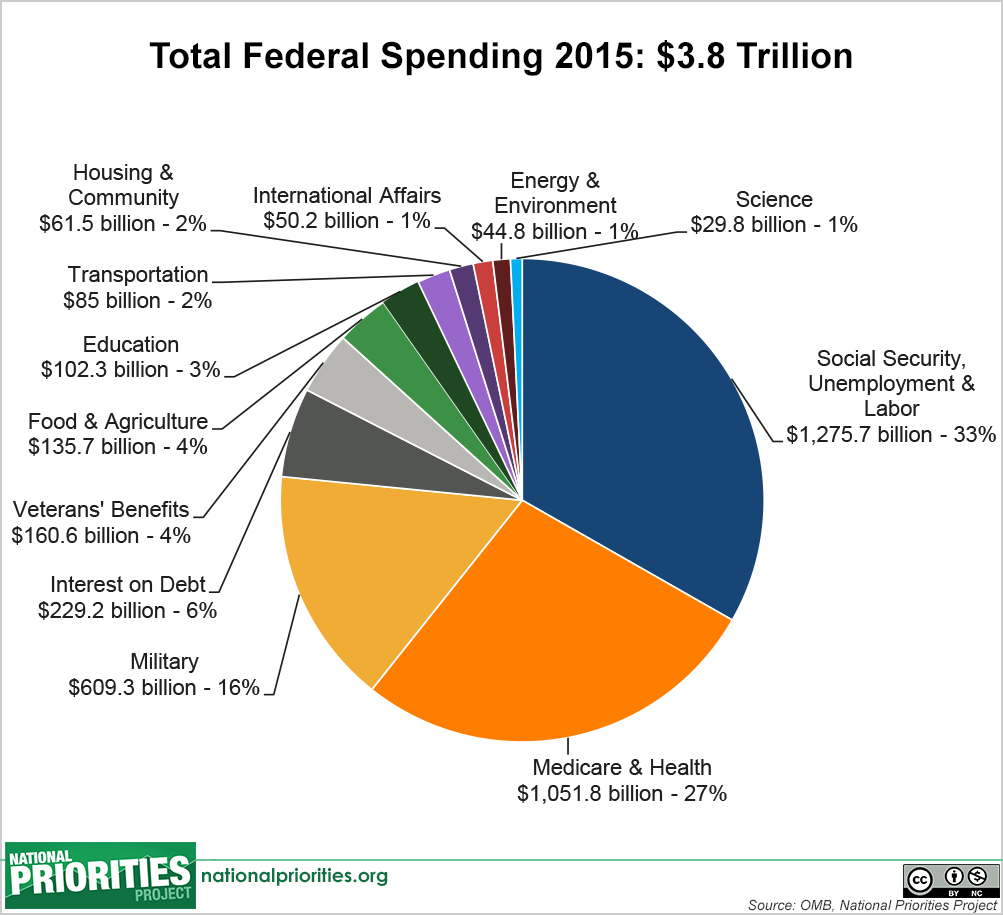
Image result for chart of U.S. government spending 1/3 of the budget goes to programs like Social Security and unemployment (not sure what labor means in this graph).  27% goes to pay for Medicare and other federal health programs.  16% of our total budget goes towards military spending, and 6% of the budget just goes to pay for the interest on the national debt (which is currently $21 trillion and growing - see National Debt link below).  That's like paying the minimum amount due on a credit card without paying the balance off. 

We can pressure our Congressmen and women about spending too much by writing letters / emails. You are the future voters. Get educated now about the National Debt.   Check here for an up-to-date look at the National Debt - http://www.usdebtclock.org/

Your job: 
1. Which do you think is a fairer tax - the flat tax or progressive tax?   Why? 
2. If you were rich, which tax would you prefer and why? 
3. Since our federal government is spending more than it is bringing in, how do you think the federal government should stop this deficit?  Decrease spending or raise taxes?  Both?  Why?  If we're cutting spending, where do we cut and why?  If we raise taxes, who pays and why?  

300 words minimum for all three questions.  Due Monday, October 22 by class.  

Friday, October 09, 2009

Blog #22 - Flat tax or progressive tax?

Near the end of this week, we discussed the 16th Amendment and the income tax - its fairness and unfairness. Its opponents have proposed a flat tax that everyone pays the same rate across the board: 20%. That way, if you earn more, you technically pay more. So, in some ways it sounds progressive.

The argument for the flat tax focuses on several arguments:
1. It eliminates special- interests by treating all taxpayers equally. Taxpayers will no longer be able to "scam the system by hiring enough lawyers, accountants and lobbyists."
2. It will boost economic growth by allowing businesses and investors to invest more money (saved by not giving as much money in taxes) into other businesses and ventures.
3. It eliminates the capital gains tax, the estate tax (other people call it the "death tax"), and double taxes on savings (taxed once when you earn it and it's deposited into the bank and then twice at the end of the year as part of your income though it already is in your bank account).
4. It's amazingly simple. Household income tax forms are now done on a postcard. It also treats all businesses the same: "Microsoft to a hot dog stand would play by the same rules."

Arguments for the progressive tax include:
1. All Americans benefit from two of our government's responsibilities, protection (police, firefighters, public health, military) and empowerment (roads, public education, banking system for loans and economic stability, SEC for the stock market, courts, national parks, public buildings, etc.), and they should be available to everyone. We are financially responsible to maintain these so that they may be used for the common good. These protections are maintained through taxes.
2. The wealthy (corporations, investors and other wealthy individuals) pay more into the system because "our taxes create and sustain, [and] empower the wealthy in myriad ways to create their wealth." In other words, they have benefited from the system in place, they should pay to maintain it.

"Consider Bill Gates...Though he has undoubtedly benefited from his unusual
intelligence and business acumen, he could not have created or sustained his
personal wealth without the common wealth [of the United States]. The legal
system protected Microsoft's intellectual property and contracts. The
tax-supported financial infrastructure (phones, electricity, Internet) enabled
him to access capital markets and trade his stock in a market in which investors
have confidence. He built his company with many employees educated in public
schools and universities. Tax-funded research helped develop computer science
and the internet..." and so on.


3. The wealthy are morally obligated to sustain the American system b/c they benefit more from it than the average American. "Ordinary people rarely use the courts; most of the courts are used for corporate law and contract disputes." Therefore, the rich pay more than the poor or middle class b/c the rich utilize the system more often to create and sustain their wealth.

So, I think we have two very persuasive arguments here, but I think we're missing the real questions that we should be asking. The questions we should be asking are:
1. What are we spending our money on?
2. Why are we spending so much of our money instead of letting the American people spend it? 3. Why do we have such a huge national debt?
4. What can we do about it? Are you willing to take on this muckraking project w/ me?

We can educate Groves H.S. about the amount of money spent by our government. We can pressure our Congressmen and women about spending too much. You are the future voters. Get educated now about the National Debt.

More on the progressive tax from the Rockridge Institute - http://www.rockridgeinstitute.org/research/lakoff/progressive-taxation-some-hidden-truths/?forPrint=1

More on the flat tax from the Heritage Foundation - http://www.heritage.org/Research/Taxes/bg1866.cfm

Wednesday, March 25, 2009

Link to Ten Trillion and Counting...

Hey, I realized that PBS decided to carry the President's press conference and then something on First Lady Betty Ford. So here's a link to Frontline's website where you can watch it:

http://www.pbs.org/wgbh/pages/frontline/tentrillion/view/

Friday, May 16, 2008

Blog #22 - Which of the following is the potentially worst economic challenge we face?


We've been studying lots of economic problems facing the country: the national debt, falling dollar, skyrocketing oil prices ($128 a barrel - a new historic high as of Friday). We also looked at Detroit's failure to adapt to the increasing demand for hybrids and higher mileage cars. In addition, we looked at the spread of big box stores like Wal-Mart and Target.

Price pressure on these stores' suppliers have driven many manufacturing jobs overseas in order to keep prices low. In addition, these big stores have forced many smaller stores in the area to close b/c they don't have the purchasing power that a Wal-Mart does. This eliminates smaller businesses - ones in which people have put their hopes and dreams. These companies have also discouraged unions and employed illegal immigrants in pursuit of cost-cutting. Is the creation of these kinds of huge stores just another step in streamlining the dog-eat-dog world of capitalism?

The national debt will be a burden on ourselves and our children if we don't do something about it soon. We can't keep overspending billions and billions of dollars every year. Can we continue to ignore it? Should we raise taxes or cut spending or both? Why? Here's a link to the Treasury Dept.'s frequently asked questions http://www.treasurydirect.gov/govt/resources/faq/faq_publicdebt.htm
The Gross National Debt

Detroit has had a hard time keeping up with the demand for higher mileage cars since they've depended upon the big profits from SUVs. With consumers switching over in a big way to other companies besides the Big 3, what does this mean for Detroit and the state of Michigan?

With fuel prices going up through the roof, inflation has started to kick in a way that we haven't seen since the 1970s - way before you guys were born! Ask yor parents about how much prices went up and the long lines for gas. Just a couple of days ago, Saudi Arabia had agreed to boost its oil production up 300,000 barrels of oil, and Washington said that it would add to the "Strategic Petroleum Reserves" How do we push the country into better energy independence? Is our dependence on foreign oil creating a security nightmare for us because we are stuck in a war in the Middle East?

Which of these issues that we have studied lately do you think will be the worst potential economic problem? Why?
Due Wednesday, May 21-
150 word minimum


Tuesday, May 15, 2007

When are we gonna stop borrowing money?

This week, we read articles that went more in depth with information regarding Hurricane Katrina. One of these articles addressed the problem with the money (paying for the recovery effort) and talked about how the U.S. is getting their money by borrowing it from foreign leaders. We borrow this money in large amounts and in order to pay it back, the president ends up cutting spending on the social programs that help the people in the United States

1. When do you think the United States should draw the line and stop borrowing the money? How much money in debt do we need to be in order for the President/(Congress) to stop borrowing all of this money?
2. Do you think there is another way to help pay for our debt and to help out in case of disasters?

Kevin K.

The National Debt Clock: http://www.brillig.com/debt_clock/


The Gross National Debt

Monday, December 04, 2006

Journal #7 - Can we learn from the lessons of past imperialism?

During our look at the Spanish American War and the Filipino-American War, I tried to draw some obvious parallels between the Persian Gulf War (1990-91) and the Iraq War (2003 - present) . Hasty, short wars like the Spanish American War and the Persian Gulf War were thought to be the wars of the future: short and relatively bloodless using the latest in technology. Then there's the Filipino-American War and the Iraq War: two wars fought to quell insurgencies (though intitially Iraq was about toppling Saddam). Both wars have proven to be brutal, divisive at home, and required our soldiers to do some wicked things in order to win.

Here's a quote from the Philadelphia Ledger in 1901 about the war in the Philippines:
"Our present war is no bloodless, fake...engagement. Our men have been relentless: have killed to exterminate men, women, children, prisoners and captives, active insurgents and suspected people, from lads of ten on up, an idea prevailing that the Filipino, as such, was little better than a dog, noisome reptile in some instances, whose best disposition was the rubbish heap. Our soldiers have pumped salt water into men to "make them talk," have taken prisoner people who held up their hands and peacefully surrendered, and an hour later, without an atom of evidence that they were even insurrectos, stood them on a bridge and shot them down one by one, to drop into the water below and float down as an example to those who found their bullet-ridden corpses."

Taking into account the stuff we've learned in our imperialism unit and in the imperialism debate, what kinds of lessons can we learn from American imperialism? Any one of these questions could apply for your journal.
- Is it worth the economic security to control the destinies of countries we can barely identify on the map?
- Are we sacrificing our democratic ideals when we take over other countries and pick their rulers for them? Why or why not?
- If we continue to worry about and depend upon oil in the Middle East, how will we ever develop clean energy sources that will get us off of our dependency?
- Is our dependency upon Middle East oil a security threat? Why or why not?
- When we are $8.659 trillion in the hole, how can we afford to be everywhere around the world?


Pick a question or come up with another angle on how we can learn from our past history of over 100 years of imperialism.

Editor's Note: We didn't amass this monstrous $8.659 trillion dollar debt just on Iraq alone. It started in 1969 when we were fighting the War on Poverty and the War in Vietnam at the same time. Then, we started outspending the Soviet Union during the 1980s to win the Cold War. That didn't happen until 1991. After 1991, our government was huge and wasteful, but still provided essential services. President Clinton signed a huge tax package to begin chipping away at the national debt in 1993, and by 1999, taxes along with a booming economy helped the government start to slowly pay down some of the debt. That all changed w/ President G.W. Bush.

Plus, there is security to think about when America acts as we do. Are we acting in our own best interests for vital resources, strategic locations, and the security of the nation?

- G.W., your devil's advocate!