Tuesday, April 15, 2008

Blog #19 - Is the world ready for American democracy?

As we talk about American foreign policy, we've discussed what our goals and guiding principles should be. Our foreign policy goals, as we have collectively discussed in 3 different classes, seem to be:

  1. protect U.S. freedoms at home
  2. improve the quality of life around the world
  3. promote democracy
  4. gain allies
  5. become wealthier as a nation by promoting trade
  6. to maintain our status as the world's superpower.

Today, we discussed how the U.S. might act in situations involving human rights violations (we used China as an example) or genocide (Rwanda, Bosnia, and Darfur come to mind). In addition, many other scenarios could come to mind when thinking about how America should act - how should we treat our allies? Should we honor treaties that we've signed 40 years ago but don't really fit our needs now? What kinds of trade practices should we follow? With these and many other questions, we could fill the rest of the year w/ debate and discussion.

But, right now, I just want to focus on two:

1. Should America's #1 foreign policy goal be to spread democracy around the world? Why or why not? (Think about the assumptions as mentioned in your textbook -pgs. 894-895)

2. Should America be the world's policeman, creating order out of chaos, helping ending conflicts, etc.? Why or why not? Please check these links for a debate about this actual question:

http://www.npr.org/templates/story/story.php?storyId=19180589 - NPR audio file of the debate.

http://www.intelligencesquaredus.org/TranscriptContainer/AmericaWorldPoliceman%20021208.pdf - transcript of the debate.

Answer only one of these questions in a thoughtful paragraph of a minimum 150 words. Your answer is due Wednesday before class.

Thursday, April 10, 2008

Blog #18 - D.I.Y. Blog - Git 'Er Done!

(Before we begin, I must say that I have been highly impressed with the quality of the thinking and the depth of analysis that has gone into the questions. I am especially impressed by the students who I am working w/ for the first time this semester - wrapping your head around these blog questions can be a little tricky sometimes. Well done, and keep up the good work!)

During this Civil Rights and Women's Rights movements unit, we've seen a lot of injustice and been witness to tremendous acts of courage and bravery. I think that there are still many questions left unanswered, so I decided to let you guys ask the questions for a change.

1. Do you think that affirmative action is good or bad for America? - Tyler F., Phil,

2. If Hillary Clinton and Barack Obama were competing for different political parties instead of the same party, who do you think would win the national election for the presidency? Why? - Alyssa T.

3. If you were Fannie Lou Hamer, would you feel that registering to vote was worth all the hassle after? - Derek M., Raekeshia,

4. What if Malcolm X and Dr. Martin Luther King were alive today?

  • How would they react to today's tragedies like Hurricane Katrina?


  • How would the world be different today if they were alive? - Jake C.


  • Which one's tactics/philosophy would you join today? - Kelsey

5. Do you think the things that Senator Obama said in his speech about distractions from the real problems that face America is true or not? Why? - John C.

6. Why do you think someone so unimportant to politics like Bill Russell (or other sports figures in today's world) can have such a big social/cultural impact on America? - Matt Bergin

7. How could the response to Hurricane Katrina have been improved? - Jourdan, Jessica, Jason S., Paul, Carleigh, Ian,

8. Do you think we would be closer to energy independence and newer forms of alternative fuel if if Al Gore had won the election in 2000 instead of George W. Bush? - Tyler H.


9. Which do you think had a bigger impact on the country and why: the Civil Rights or the women's rights movement? - Rob S., Robbie L.,


10.If you were a leader of the Civil Rights Movement back then, would you be a leader more like Dr. King or more like Malcolm X with regard to philosophy and tactics (non-violence vs. by self-defense / convert the opponent vs. black power and nationalism)? Or would you be something completely different? Why? - Stefan, Stefanos, Amber


11. Why is it taking so long to rebuild and repair New Orleans? - Nick


12. How would life be different for women if the E.R.A. amendment had been passed? - Matt Bajorek, Raffi


13. Why did the Bush administration take so long to get down to New Orleans after Katrina? - Ashley D., Alex D., Bethany, Raffi, Ian, Raekeshia, Stefanos,

14. Has women's advancement during the past 40-50 years hurt or helped men? Why? - Nikita

15. Women have always had difficulty with gaining equality and respect from men. So, why would some women dress scantily and only care about their looks to attract men? If women truly wanted to be better, why act dumb and do nothing? - Emma


16. Why do you think women in the 1950s were so dissatisfied with living "the ideal life" as a housewife? - Mollie, Tommy


17. In your opinion, would the appearance of the current female image of "beauty" have changed if pop culture sensation Twiggy not been discovered? Why or why not? - Angelina, Gina


18. Will discrimination ever be over in the future? - Audrey


19. Even though V.P. Al Gore had won the popular vote in the 2000 election, he lost the electoral vote to Governor George Bush. Do you agree that the current voting system we have is o.k. (with the electoral college) or should it be reformed to something else? - Paul


20. Was the non-violent protest method the best way to fight Jim Crow and establish Civil Rights? Why or why not? - Bethany, Sarah, Raffi, Ryan, Marin, Christy, - (It may be easy to judge this in retrospect since it worked, but would a self-defense strategy have worked faster or provoked a more violent reaction from a very racist, resistant South? - the editor)


21. Pretend you didn't know the outcome of the Children's March: would you have taken a stand with the other kids of Birmingham, AL in May of 1963? Why or why not? - Lydia, Angelina, Bethany, Sarah, Kelsey, Ally R., Amber


22. If you were 18 this year, who would you have voted for in each of the primaries and why? - Robert G.


23. If you had lived in New Orleans or in the Gulf Coast region in late August 2005 and Hurricane Katrina was bearing down on the area (pretending you don't know the aftermath, of course), would you have evacuated or stuck it out? Why? Why do you think so many people who could leave stayed? - Sarah


24. Who do you think was the most influential woman in the women's movement? Why? (here's a link to help you with your decision - http://www.legacy98.org/move-hist.html )- Ben, Ally R.


25. Were there parts of Senator Obama's speech of March 2008 that you agreed / disagreed with? Why? - many people asked this question in several different ways.


26. The children of Birmingham, AL marched for freedom. Despite being jailed, their attempts eventually worked, and things became integrated in the South. Many people think that kids can't change history even though here is at least one example that proves them wrong. What would students / teenagers today march for and feel strongly enough to fight for (and maybe even be willing to go to jail in protest)? - Katie B.


27. Do you think you would have urged your state representative to vote for the E.R.A. Amendment back in the 1970s or would you have worked w/ Phyllis Schlafly to defeat the amendment? Why? - Christy


28. How can you try someone for a crime in 2005 that he/she might have committed in 1964 like with the Mississippi Burning case? - Emily C.


29. Why did it take so long for President Kennedy to react to the racism going on in his own country back in the early 1960s? - Lorne


30. How do you think sexual independence has changed women's roles in society today? (Others have asked similar questions about the Pill or Helen Gurley Brown's book, Sex and the Single Girl) - Claire, Tommy


31. What do you think the "proper shape" is for men and women today? - Ryan B.


Pick any one of these questions and answer it fully. You may NOT pick your own blog. Minimum word reply is 200 words.
Due Monday, April 14th, 2008.

Wednesday, April 09, 2008

The Daily Show: Celebrity Endorsements


This is a hilarious look at celebrity endorsements when (it seems) everyone in Hollywood is taking sides in the 2008 Election.

Thursday, April 03, 2008

Blog #17 - Why do you think women have had such a hard time?

Throughout the course of American history, in the land of the free, where "all men are created equal", women have had such a difficult time achieving and maintaining equality. From the time Abagail Adams reminded her husband, John Adams, to include something about women's rights in the Declaration of Independence to Hillary Clinton's Presidential campaign, women have had an uphill road to walk for equality.

Question: Why do you think their (women's) road has been so tough in their fight for equality?

Things to consider: Everyone in America a woman (1/2 the population given the 2000 census) or has been touched by, involved with women in some way or another; with such a close relationship, how can men NOT be influenced to accept women as equals? Is there something built-in to our culture - an anti-woman bias - that keeps women down or degrades them?


Why do you think Hillary Clinton is not succeeding as well as Barack Obama, especially considering that BOTH of them are historical, groundbreaking candidates? Is she losing b/c she's a woman or is she losing b/c of her policies and personality? Lastly, why do groups like Phyllis Schlafly's sabotage women's fight for rights?


200 words minimum.


Due Wednesday, April 9th - Please note new due date. Sorry this was posted so late - have had a busy weekend so far.

Tuesday, April 01, 2008

Extra Credit Blog: William Faulkner Quote

In Senator Obama's speech, he quoted Southern writer William Faulkner who had said this about history:


"The past is not dead. In fact, it's not even past."


When you think of Southern history and all that has passed between blacks and whites over the last 400 years, this quote seems to make more and more sense to me.

As we progress through this Civil Rights unit, tell me what you think the author means by the quote. Think of our history going all the way back to slavery times, the Civil War and Reconstruction, and through the Jim Crow times that Faulkner lived in.

Maximum points: 5
Minimum words: 150
Due by the end of April.

Sunday, March 30, 2008

Blog #16 - Is Fake News Good For America?

Is fake news good for America?

I pose this question for our blog b/c in many ways, though it makes us laugh and it has good reporting, it can also blur the lines between fiction and reality. First, let’s talk about the Daily Show and The Colbert Report.

Jon Stewart joined the Daily Show around 1999 or so and the show became a huge topical news hit when deadpan reporter Steve Carell (the same Steve Carell from 40 Year-Old Virgin, Dan in Real Life and Horton Hears a Hoo) got onto John McCain’s campaign bus called the Straight Talk Express and asked such goofy questions that seemed so real “that McCain didn’t know if [Carell] was joking or serious.” 1

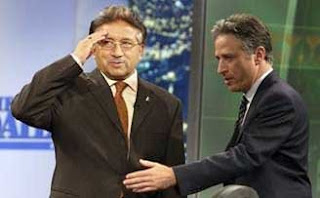
Since then, The Daily Show has become the “pit stop” for politicians looking to get re-elected or people (including politicians) looking to pimp their new books. Even the president of Pakistan, Pervez Musharraf, one of America’s most important allies in the war on terror appeared on the show last year (2007). When politicians appear on the show, they know they might get mocked, yet they play along with Stewart’s schtik anyway.
Appearing on late night shows, a tradition started by a saxophone-playing Bill Clinton on the Arsenio Hall Show in 1992, has tended to result in positive publicity for a politician. Whether it’s Leno, Letterman, Stewart, Colbert or Kimmel, “America wants to see these guys poke fun at themselves…” and “present a hipper, gentler side.” 1


Sometimes, these appearances don’t always go positively or they come too late to matter. In 1996, Senator Bob Dole went on the Late Show w/ David Letterman after he lost the election to Bill Clinton. Dole’s quick wit was such a huge hit that many voters wrote to him wishing that they had voted for him earlier. In the 2004 election, President Bush (“came off horribly wooden”) and Senator John Kerry (who rode a Harley onto Leno’s set) both flopped. 1

But, with all of these politicians playing along with the jokes and even being in on some of the gags, sometimes, a viewer might not know where the reality ends and the satire begins. Jon Stewart’s interviews are sometimes better than the ones that the professionals do. In 2000, The Daily Show won a Peabody Award for its coverage of the Bush / Gore campaign – an award that goes to people in the journalism field. And what about the Colbert Report? Stephen Colbert breaks his wrist and believes that “anything he cares about is important enough to talk about every day.” He wanted people to wear “Wrist-Strong” bracelets for wrist-awareness. 2 How much different is this silliness than Glenn Beck, MSNBC’s pundit, talking about his hemorrhoid surgery and the difficulty he had with it on TV? 3

So when we can’t tell the news from the comedy, when we can’t figure out the truth from fiction, how can we make informed decisions? How can we vote for the right candidates? Does all of this confusion mean that American democracy has become a joke? Or is it that the media isn’t doing its job b/c it is too busy following the government or corporate storyline?

The question: Is fake news good for America? Why or why not? Consider the discussion and the questions above before writing your answer (150 words minimum).
Sources:
1. Peyser, Marc. “Red, White and Funny: The new year will bring a host of intriguing faces front and center. Politicians. Actors. Tycoons. Educators. And one fake news anchor, bravely battling pomposity and misinformation. Jon Stewart prepares for Campaign 2004.” Newsweek. Dec. 29, 2003. P. 70.
2. Weinman, Jaime. “The Secret Agenda of the Colbert Report: in two years, he’s turned a “Daily Show” spin-off into a wacky sitcom.” Maclean’s. Oct. 22, 2007. P. 57.
3. The Drudge Report. http://www.drudge.com/news/102972/glenn-becks-eye-opening-hemorrhoid-surgery . Accessed 3/29/08.

Friday, March 21, 2008

The Daily Show - 5 Years in Iraq


Jon Stewart looks at the administration's underestimation of the length of the war, the terribly lame protest movement, the V.P.'s disregard for American opinion polls, and President Bush's travels back in time.

Thursday, March 20, 2008

Daily Show - Code Pink Tries to Shut Down Marine Recruiting Station


I love this clip by Rob Riggle of the The Daily Show b/c he looks at this inane group called Code Pink (apparently a take-off of the Dept. of Homeland Security's rainbow code system of security) who want to stop the Marines from recruiting in Berkley, California - one of the most liberal places in America. Riggle uses their own comments to show how lame, unfocused and ineffective the anti-war movement is today - he doesn't have to say much, he just uses their own words against them. It's satire at its finest.

Fake News - The Colbert Report


Here is an interview on a "fake news" channel, The Colbert Report, of Samantha Power, the woman we saw in No End in Sight, talking about her new book about Sergio Vieira de Mello, the U.N. fix-it guy that was killed in the truck bomb incident in August 2003. She called him the "most important man we've never heard of."

Wednesday, March 12, 2008

Blog #15 - After September 11, 2001....

Many of you were 9, 10 or 11 years old when this tragic event happened, and that's part of the reason why I feel the need to start the semester with those horrible events of that perfect, blue-sky Tuesday morning in late summer 2001.

In the video we watched together, In Memoriam: New York City: 9/11/01, we saw some awful images - maybe they were new for you, maybe not.

I'd like you to answer a couple of questions:

1. Pretend you don't know anything about what's happened in the six and a half years since 9/11/01 - just pretend. How would you want America to respond to this attack that left 3,000 dead and over 15,000 wounded?

A few things to think about when you answer this question: Would you respond militarily by attacking Al-Qaeda? Would you respond diplomatically by trying to isolate Al-Qaeda economically and help eliminate the sources of poverty? Would you work to improve America's image within the Arab world? Or is there another alternative? What could Americans have done at home to make a difference? (include some of your notes from the video here).


2. Question #2 - Do you believe that the Presidential candidates will be able to do what they say about Iraq? Why or why not?

Alternate question #2 (in case you don't like the first question #2) - Should we remain in Iraq and stabilize the country, withdraw gradually, or leave as quickly as possible? Why?

The Iraq War is now coming up on its 5th year anniversary and few see an end in sight. Click here for the latest opinions on the war from Gallup Poll : http://www.youtube.com/watch?v=zCAaYzFdrm0 (it's very short -only 1:30 long).

So far, almost 4,000 American soldiers have been killed and over 15,000 injured. The war has cost over $3.1 trillion dollars, and America is in the middle of a recession. Gas prices are predicted to hit $4.00 by Memorial Day (a little over 2 months away) and oil prices keep hitting new historic high prices ()$108 a barrel just the other day - 3/11/08). Americans are divided over the war and how to finish the war.

Obama, Clinton and McCain are debating what to do with Iraq and Afghanistan - should I stay or should I go now? Many Americans think that by leaving too early we will leave Iraq as a breeding ground for terror (much like Afghanistan turned into one in the 1990s). Others feel like we need to increase the number of troops. Others feel like that we broke Iraq, we need to fix it.

John McCain: "A greater military commitment now is necessary if we are to achieve long-term success in Iraq. John McCain agrees with retired Army General Jack Keane that there are simply not enough American forces in Iraq. More troops are necessary to clear and hold insurgent strongholds; to provide security for rebuilding local institutions and economies; to halt sectarian violence in Baghdad and disarm Sunni and Shia militias; to dismantle al Qaeda; to train the Iraqi Army; and to embed American personnel in Iraqi police units."
http://www.johnmccain.com/Informing/Issues/

Hillary Clinton: "The most important part of Hillary's plan is the first: to end our military engagement in Iraq's civil war and immediately start bringing our troops home. As president, one of Hillary's first official actions would be to convene the Joint Chiefs of Staff, her Secretary of Defense, and her National Security Council. She would direct them to draw up a clear, viable plan to bring our troops home starting with the first 60 days of her Administration. " http://www.hillaryclinton.com/issues/

Barack Obama: "Obama will immediately begin to remove our troops from Iraq. He will remove one to two combat brigades each month, and have all of our combat brigades out of Iraq within 16 months. Obama will make it clear that we will not build any permanent bases in Iraq. He will keep some troops in Iraq to protect our embassy and diplomats; if al Qaeda attempts to build a base within Iraq, he will keep troops in Iraq or elsewhere in the region to carry out targeted strikes on al Qaeda." http://www.barackobama.com/issues/

Each of your answers to the questions should be a minimum of 100 words.

This song, "Belief", by John Mayer fits this conflict between America and radical Islam so well:

Is there anyone who / Ever remembers changing there mind from
The paint on a sign?

Is there anyone who really recalls / Ever breaking rank at all
For something someone yelled real loud one time

Everyone believes / In how they think it ought to be

Everyone believes / And they're not going easily

Belief is a beautiful armor / But makes for the heaviest sword
Like punching under water / You never can hit who you're trying for

Some need the exhibition / And some have to know they tried
It's the chemical weapon / For the war that's raging on inside

Everyone believes / From emptiness to everything
Everyone believes / And no ones going quietly

We're never gonna win the world
We're never gonna stop the war
We're never gonna beat this
If belief is what we're fighting for

What puts a hundred thousand children in the sand
Belief can / Belief can
What puts the folded flag inside his mother's hand
Belief can / Belief can


I felt that this picture of the parents of Marine Sgt. Robert Courtney, killed by a suicide bomber in Iraq on October 30, 2004, fit the song well("what puts the folded flag inside his mother's hand?"). For every number that we hear on the news... "3 American soldiers killed by a mortar attack in Fallujah..." there is a whole group of people behind that one person who was killed or wounded. This is the human cost of what is being done in Iraq and Afghanistan.

Monday, February 11, 2008

Blog #5A - Is America an Empire?

There have been dozens of books written lately about how America has become an empire - especially with the invasion of Iraq in March 2003. Here's just a sample:


The premise of many of these books is that whether we like it or not, America is an empire. Whether we like acknowledging it or not is whole other thing.


When many people think of empires, we tend to think of the ancient Romans with their gladiators and colisseums, or the British Empire and some guy in a funny-looking pith helmet tromping through the African jungle: "Dr. Livingston, I presume?" With the word "empire" or "imperialism" comes so much negative baggage; plus, those words are so down-right anti-democratic. If we're controlling the destinies of other countries, how are we allowing them to be democratic and free nations?
Being an imperialist nation, apparently, has been something we've been working at for several decades now. A book by Stephen Kinzer called Overthrow outlines over a dozen instances where the United States has taken control of a country b/c our business or political interests were threatened, resources were slipping out of control, or during the Cold War, we felt the creep of socialism get too close.
We've talked about how widespread American military is across the world: 700 military bases in 60 countries; 1.4 million soldiers. There's an upside to all of this - don't get me wrong! Because of these brave men and women, we're so much safer than we would be without them. I am grateful for theirs and their families' sacrifices.

The question to answer: Is America an empire?
Questions to consider but not necessarily answer - is the course we've taken towards building an empire worth the hatred of the world? Our safety doesn't mean much when terrorists want to kill us at home. Morally, are we doing the right thing by keeping other countries from determining their own destiny? Economically, is the tax money we're spending on our military also the right thing to do? Should the other countries of the world shoulder their own defense expense? Why or why not?
Minimum response - 250 words - due Wednesday - 2.13.08
Find out how we overthrew Iran in 1953: A Folly of Attacking Iran: Lessons from History - http://www.youtube.com/watch?v=AJRcOF7rEfQ

Journal #13B - 40 different ways to look at JFK

After reading and listening to the different views of President Kennedy's life as seen through different biographers' eyes, it's time for your opinion/assessment.

John Kennedy's biographers are usually broken into two groups: one group works to reinforce the image of Kennedy as icon, as the ideal president. They tend to gloss over the difficult stuff in his life with the idea that it's not important to know that kind of info about him. These biographers also stress his good qualities and downplay his bad qualities.

The second group of biographers are iconoclasts; they are trying to poke holes in the JFK myth by finding evidence to refute many of the cherished (and false) stories about the Kennedy family, clan, and presidency. These biographers are like realist authors - they give you the gritty details of a person's life; the fact that this person was the president doesn't seem to phase them.

The American people have consistently voted JFK (along with Lincoln) as their greatest American President, yet historians have given him the title "Most Overrated" in American Heritage magazine. When looking at his Congressional record, he didn't do much. Almost the same thing can be said for his Presidential record; how significant were the Peace Corps and the race to the moon in the long run?

Your job: answer the following questions:
1. Share your assessment of the man and his job as president by looking back at your notes on the 8 sections of the book. Explain your reasoning with specific examples.
2. Where should biographers draw the line on their subjects? How much is too much and how little is too little?It really boils down to what the main job of a biographer is.

250 words minimum. -Due Wednesday - 2/13/08

http://www.maryferrell.org/wiki/index.php/Main_Page - Great link to a tribute website to a JFK archivist, Mary Ferrell.

Thursday, January 31, 2008

Blog #12B - Good Night and Good Luck

Choose three statements – one from each speech – and discuss how each statement can be applied to our world and political or social situations today.

" No one familiar with the history of this country can deny that congressional committees are useful. It is necessary to investigate before legislating, but the line between investigating and persecuting is a very fine one and the junior Senator from Wisconsin has stepped over it repeatedly. His primary achievement has been in confusing the public mind, as between the internal and the external threats of Communism. We must not confuse dissent with disloyalty. We must remember always that accusation is not proof and that conviction depends upon evidence and due process of law. We will not walk in fear, one of another. We will not be driven by fear into an age of unreason, if we dig deep in our history and our doctrine; and remember that we are not descended from fearful men. Not from men who feared to write, to speak, to associate, and to defend causes that were for the moment unpopular.

This is no time for men who oppose Senator McCarthy's methods to keep silent, or for those who approve. We can deny our heritage and our history, but we cannot escape responsibility for the result. There is no way for a citizen of a republic to abdicate his responsibilities. As a nation we have come into our full inheritance at a tender age. We proclaim ourselves, as indeed we are, the defenders of freedom, wherever it continues to exist in the world, but we cannot defend freedom abroad by deserting it at home. The actions of the junior Senator from Wisconsin have caused alarm and dismay amongst our allies abroad, and given considerable comfort to our enemies. And whose fault is that? Not really his. He didn't create this situation of fear; he merely exploited it — and rather successfully. Cassius was right. "The fault, dear Brutus, is not in our stars, but in ourselves." Good night, and good luck."
– See it Now broadcast, March 9 1954

If we confuse dissent with disloyalty — if we deny the right of the individual to be wrong, unpopular, eccentric or unorthodox — if we deny the essence of racial equality then hundreds of millions in Asia and Africa who are shopping about for a new allegiance will conclude that we are concerned to defend a myth and our present privileged status. Every act that denies or limits the freedom of the individual in this country costs us the . . . confidence of men and women who aspire to that freedom and independence of which we speak and for which our ancestors fought."
– Ford Fiftieth Anniversary Show, CBS and NBC, June 1953

“We are currently wealthy, fat, comfortable and complacent. We have currently a built-in allergy to unpleasant or disturbing information. Our mass media reflect this. But unless we get up off our fat surpluses and recognize that television in the main is being used to distract, delude, amuse and insulate us, then television and those who finance it, those who look at it and those who work at it, may see a totally different picture too late.

Our history will be what we make it. And if there are any historians about fifty or a hundred years from now, and there should be preserved the kinescopes for one week of all three networks, they will there find recorded in black and white, or color, evidence of decadence, escapism and insulation from the realities of the world in which we live. I invite your attention to the television schedules of all networks between the hours of 8 and 11 p.m., Eastern Time. Here you will find only fleeting and spasmodic reference to the fact that this nation is in mortal danger. There are, it is true, occasional informative programs presented in that intellectual ghetto on Sunday afternoons. But during the daily peak viewing periods, television in the main insulates us from the realities of the world in which we live. If this state of affairs continues, we may alter an advertising slogan to read: LOOK NOW, PAY LATER.

For surely we shall pay for using this most powerful instrument of communication to insulate the citizenry from the hard and demanding realities which must be faced if we are to survive. I mean the word survive literally. If there were to be a competition in indifference, or perhaps in insulation from reality, then Nero and his fiddle, Chamberlain and his umbrella, could not find a place on an early afternoon sustaining show. If Hollywood were to run out of Indians, the program schedules would be mangled beyond all recognition. Then some courageous soul with a small budget might be able to do a documentary telling what, in fact, we have done--and are still doing--to the Indians in this country. But that would be unpleasant. And we must at all costs shield the sensitive citizens from anything that is unpleasant.

I am entirely persuaded that the American public is more reasonable, restrained and more mature than most of our industry's program planners believe. Their fear of controversy is not warranted by the evidence. I have reason to know, as do many of you, that when the evidence on a controversial subject is fairly and calmly presented, the public recognizes it for what it is--an effort to illuminate rather than to agitate.

I do not advocate that we turn television into a 27-inch wailing wall, where longhairs constantly moan about the state of our culture and our defense. But I would just like to see it reflect occasionally the hard, unyielding realities of the world in which we live. I would like to see it done inside the existing framework, and I would like to see the doing of it redound to the credit of those who finance and program it. Measure the results by Nielsen, Trendex or Silex-it doesn't matter. The main thing is to try. The responsibility can be easily placed, in spite of all the mouthings about giving the public what it wants. It rests on big business, and on big television, and it rests at the top. Responsibility is not something that can be assigned or delegated. And it promises its own reward: good business and good television.

To those who say people wouldn't look; they wouldn't be interested; they're too complacent, indifferent and insulated, I can only reply: There is, in one reporter's opinion, considerable evidence against that contention. But even if they are right, what have they got to lose? Because if they are right, and this instrument is good for nothing but to entertain, amuse and insulate, then the tube is flickering now and we will soon see that the whole struggle is lost.

This instrument can teach, it can illuminate; yes, and it can even inspire. But it can do so only to the extent that humans are determined to use it to those ends. Otherwise it is merely wires and lights in a box. There is a great and perhaps decisive battle to be fought against ignorance, intolerance and indifference. This weapon of television could be useful.

Speech at Radio-Television News Directors Association, Chicago, October 15, 1958.

Sunday, January 27, 2008

Blog #11B - Should the government tell us the truth?

Back in the 1950s, Americans practiced "Duck and Cover" drills when the threat of nuclear war became greater with the Soviet Union during the Cold War. Films about Bert the Turtle would help America understand the necessity of hiding out the blasts.


These drills would save the children of America from the nuclear blast, apparently, and then we could come out afterwards as if it was a bad storm and rebuild. The government even downplayed the damage done during a nuclear war: in a 1955 film called "About Fallout", it says that "radiation is something that we live with everyday." While technically correct, high levels of toxic radiation left after a nuclear blast isn't what I think he's talking about. If you'd like, check out the film here: http://www.youtube.com/watch?v=Dobys9s9f2w


Without proper shelter, the film says, millions will die from the fallout. 2 feet of earth, 5.5 feet of wood will help protect us. Time is also our ally, the film says. Within 2 weeks, mostly all the radiation is decayed. One thing I found odd was when it said (and I'm paraphrasing here):


that if radiation falls on your food, the food isn't harmed or made radioactive
b/c radiation damages living tissue. Simply remove the fallout particles
with regular everyday food preparation methods... if you accidentally swallow
fall out particles, they will do you no immediate harm (!) [at this point, it
shows a 1950s in an apron -with no gloves - rinsing off tomatoes in a
kitchen].

It seems laughable today, given the immense power of the nuclear bombs that simple drills like these could keep Americans safe. Someone must have known how bad these bombs were and how devastating they would have been had they hit American cities. They would have made the 9/11/01 attacks look tame by comparison in both death toll and destruction. This isn't to minimize those horrific terror attacks, but those airplanes weren't nuclear bombs. And most of the damage in New York was done, in my opinion, by the falling WTC buildings, not the airplanes.

Today, I get the same feeling that we aren't being told the complete and utter truth about how to defend ourselves against possible bio and chem weapons attack. In 2002, when we were told about plastic sheeting and duct tape, I thougt it laughable too, but in the back of my mind, I thought, "what if...?" and I went out and bought some anyway. SUCKER!
What else should I do? Go to an army surplus store and buy gas masks? Stock up on food supplies and water? Get a gun just in case? And whose job is it to protect us? Ourselves? Homeland security?
So, the questions are:
1. Should the government have told Americans the cold hard facts about nuclear war in the 1950s instead of shielding them from the truth? Why would the gov't. have concealed this info from us? How do you think the American people would have reacted when told? Why?
2. Is the gov't. doing all it can to help us prepare for the next terrorist attack - whatever, wherever, whenever it may be? If not, what needs to be done? If so, what have they done to help us in the Detroit area?
Due Wednesday, January 30 (200 words minimum).

Friday, January 25, 2008

Blog #4A - Illegal Immigration

A big topic in this election year has been the candidates' stance on illegal immigration. There are an estimated 12 million illegal immigrants in the United States currently w/ approx. 400,000 coming in every year. Most of these folks have arrived as tourists and have overstayed the terms of their visas so they are not the ones that you might envision sneaking across the border in the middle of the night. In order to survive, many of the illegals take jobs that don't require Social Security numbers or they find employers who don't do background checks. Many of these jobs are ones that some Americans don't want. So, these folks are criticized for not paying their taxes. Yet, I wonder, how can they pay their taxes if they're not allowed to have a SS card or #?

So, my questions for you concern the future treatment of illegal immigrants:
1. Should children of illegals be allowed to go to public schools? Why or why not?
2. Should the current illegals that are here now be given the opportunity to become American citizens? Why or why not? If so, under what conditions? If not, what should happen to them?
3. Should prevent future illegal immigrants from coming to America? Do we need to build a wall? Increased border patrols? Or, should we relax our immigration restrictions so that more people can share in the American dream? Why?

Your answer is due Monday, January 28, and should be a minimum of 200 words. Thanks.

Extra credit opportunity: research one of the 8 remaining Presidential candidates (Clinton, Obama, Edwards, McCain, Huckabee, Romney, Ron Paul, and Guiliani) and find out what his/her views are on immigration. Then, summarize those views in 2 paragraphs in your own words. You can email this to me or turn it in by Wednesday, January 30th.
- One suggestion on research - check the candidate's website for accurate information on immigration. If you just type in "Obama + immigration" into a search engine, you're liable to find all kinds of crazy junk out there. Remember, the internet is a tool, but it's also a place where anybody can publish anything.

Sunday, January 13, 2008

Blog #10B The Right Reasons?

Many people will look back at the use of the atomic bombs on Japan in 1945, and with perfect hindsight, question the wisdom of dropping the bombs. The critics will point to Cold War and the creation of over 40,000 nuclear bombs just by the Soviet Union and the United States alone between 1945-1991. The critics will point to the current spread of nuclear weapons to rogue countries like Iraq, Iran, and North Korea. Furthermore, there's no clear location on dozens if not hundreds of nuclear warheads lost after the collapse of the Soviet Union.

But, many people, including respected historians, will assert that the bombs ended the war. Would Japan have surrendered w/o the destruction of two whole cities? Possibly. But, when faced with the prospect of dozens of Okinawa battlefields, President Truman agreed to their use. He had hoped to avoid the death of countless hundreds of thousands of Allied and Japanese soldiers.

So, in 150 words, looking over your notes for Okinawa and how that influenced the decision to drop the bomb, do you think the U.S. dropped them for the right reasons? Or did the eventual consequences listed in the first paragraph outweigh the end of the war? Explain why.

Sunday, January 06, 2008

Blog #9B - Would you fight if drafted?

As the American military has been stretched thinner and thinner by our commitments in Afghanistan and Iraq in the past six years plus the falling retention rate of soldiers, talk of reinstating a draft has continued to come up. This talk of a draft is like that dandelion in your yard that just won't go away.

In 2003, on the eve of war with Iraq, a bill was introduced in Congress that called for reinstating the draft but with much fairer provisions than the one that was ended in the mid 1970s used to fight the Vietnam War. Back then, the poor and minorities were drafted much more often than wealthy white males who had connections and could use them to get out of the draft (Bill Clinton), or get nice national guard duty (George W. Bush, former V.P. Dan Quayle), or get medical deferments (Dick Cheney). Many other wealthy people got to use college deferments as a way to get out of the draft.

This new bill introduced in 2003 would supposedly eliminate all of these deferments and make it harder for American citizens to move to and live in Canada to evade the draft. The bill called for 2 years of service to the American government for both men and women between the ages of 18-26. The bill sat in committee for over a year and a half and then was finally voted down overwhelmingly (402-2 in the House on HR 163) a month before the 2004 election. Gee, what a surprise!
During the time period we're studying, World War 2, the U.S. also needed a draft to supply the soldiers to fight fascism. According to our textbook, 5 million men volunteered for the war, and the draft was expanded to include another 10 million.
Currently, there is no draft. According to this CBS News article that I found, http://www.cbsnews.com/stories/2006/12/22/national/main2291979.shtml, sometime in the near future (before 2009 - the story was published Dec. 22, 2006) the government will test the Selective Service System which hasn't been tested since 1998. But, as evidenced by General Lute's testimony here, some people still think it's a good idea.
So, my questions for you are:

1. If drafted when you're old enough to fight in the war on terror, would you fight? Why or why not? Would it depend on the situation or is it important that you answer the call when your country needs you? Why?

2. If you had lived during World War 2 times and the Japanese had just bombed Pearl Harbor (and you're of draft age), BOYS - would you have volunteered or waited to have been drafted? Explain your answer.

GIRLS - Would you have supported your father's/brother's/ boyfriend's/husband's choice to volunteer for the war or would you have encouraged him to wait? Why?

(100 words minimum for each question - 1 and 2 - is fine).

Before you answer, you may want to read this pro/con piece from a couple of veterans at Georgia Tech University. http://www.cc.gatech.edu/~tpilsch/History/Reinstate.html Both of them bring up some very valid points for and against a draft.

Sources:
1. June 2007, Bush War Advisor Says Draft Worth A Look. http://www.commondreams.org/archive/2007/08/11/3117/
2. Dec. 22, 2006, Military Draft System to be Tested.

Thursday, January 03, 2008

Blog #3A - Indian Mascots - Right or Wrong?

We've seen them for years - the Cleveland Indians and the Washington Redskins are probably two of the biggest sports franchises that have continued to use Native American mascots. In 2001, the Redskins were urged to change their mascot by a retired school teacher. Team spokesman Carl Swanson responded, “We appreciate people’s concerns about our team name. However, a Native American was the first owner of our team. He gave the team its name. The people of the area and fans of the team understand that Redskins symbolize the greatness and strength of a proud people.”


Some of the logos you also see here belong to the Kansas City Chiefs, the Atlanta Braves and the Florida State Seminoles. I recently mentioned that the NCAA had issued a ban on all Indian mascots unless the university met certain criteria. Florida State was one of the universities allowed to keep their mascots.


Quoted from Tolerance.org on the mascot issue:

Barbara Munson, a member of the Oneida Nation and an activist with the Wisconsin Indian Education Association, explains:

"We experience (the use of Native mascots) as no less than a mockery of our cultures. We see objects sacred to us - such as eagle feathers, face painting and traditional dress - being used not in sacred ceremony, or in any cultural setting, but in another culture's game.

Yes, we are proud of the warriors who fought to protect our cultures from forced removal and systematic genocide and to preserve our lands from the greed of others. We are proud, and we don't want them demeaned by being "honored" in a sports activity on a playing field.

Indian men are not limited to the role of warrior; in many of our
cultures a good man is learned, gentle, patient, wise and deeply spiritual. In present time as in the past, our men are also sons and brothers, husbands, uncles, fathers and grandfathers.
Contemporary Indian men work in a broad spectrum of occupations, wear contemporary clothes, and live and love just as men from other cultural backgrounds do.
The depictions of Indian “braves,” “warriors” and “chiefs” also ignore the roles of women and children. Many Indian Nations are both matrilineal and child-centered.

Indian cultures identify women with the Creator, because of their ability to bear children, and with the Earth, which is Mother to us all.
In most Indian cultures the highest value is given to children — they are closest to the Creator and they embody the future.
"

Go to YouTube and check out the video - "How Hollywood Stereotyped the Native Americans". It's about 5:20 and it shows the way movies and TV programs portrayed Indians. It's extremely thought-provoking. Hopefully this
url works:

http://www.youtube.com/watch?v=_hJFi7SRH7Q

So, what's your opinion? Should high school, college or even professional teams be allowed to have Indian mascots? Why or why not? 150 words minimum.

Issues to think about:

1. What if situations were reversed and other ethnic groups were used instead? Would that be acceptable?

2. Do you force a professional team to change their mascot? How?

Sources:

1. You Tube: http://www.youtube.com/watch?v=_hJFi7SRH7Q

2. Tolerance.org - http://www.tolerance.org/news/article_tol.jsp?id=168

3. In Whose Honor? A Documentary Film - http://www.inwhosehonor.com/

4.

Wednesday, December 12, 2007

Blog #2A - Reconstruction

I'll throw out those two focus questions that I posed on Monday for discussion (and then add the third one as well):

1. Do you think the South should have been punished or forgiven for their role in the Civil War? Why?

2. After all that happened, do you think that Reconstruction was a success or failure? Which one and why?

3. Does Andrew Johnson deserve to be in the Top 5-10 worst Presidents lists that he is normally put in? Why or why not?

Since I'm posting this around 9:40 p.m. on Wednesday night, I'll take posts until Friday (12/14/07) at the beginning of class. Minimum of 150 words. Thanks. Sorry for the delay.

Wednesday, December 05, 2007

Blog #8B - Pick a quote on America

Blog #8B: Pick one of these quotes and tell me what you think the speaker means by it and what he/she is saying about America specifically (150 words minimum). Do not just rephrase the quote.

1. "America's greatest strength, and its greatest weakness, is our belief in second chances, our belief that we can always start over, that things can be made better." Anthony Walton, writer


2. "America is the greatest, freest and most decent society in existence. It is an oasis of goodness in a desert of cynicism and barbarism. This country, once an experiment unique in the world, is now the last best hope for the world." Dinesh D'Souza, writer


3. "What's right about America is that although we have a mess of problems, we have great capacity - intellect and resources - to do some thing about them." Henry Ford II, US automobile manufacturer (1917 - 1987)


4. "I don't measure America by its achievement but by its potential." Shirley Chisholm, US politician (1924 - 2005)

5. "The genius of the United States is not best or most in its executives or legislatures, nor in its ambassadors or authors or colleges, or churches, or parlors, nor even in its newspapers or inventors, but always most in the common people." Walt Whitman, US poet (1819 - 1892)

6. "America is a large, friendly dog in a very small room. Every time it wags its tail, it knocks over a chair." Arnold Toynbee, English historian & historical philosopher (1889 - 1975)

Tuesday, December 04, 2007

Blog #1A - Pick a quote and answer it!

Blog #1A: Pick one of these quotes and tell me what you think the speaker means by it and what he/she is saying about history/peace specifically (150 words minimum).

Mankind must put an end to war, or war will put an end to mankind...War will exist until that distant day when the conscientious objector enjoys the same reputation and prestige that the warrior does today- John F. Kennedy

The best way to destroy an enemy is to make him a friend - Abraham Lincoln

Nothing could be worse than the fear that one had given up too soon and left one unexpended effort which might have saved the world - Jane Addams

Each must for himself alone decide what is right and what is wrong, and which course is patriotic and which isn't. You cannot shirk this and be a man. To decide against your convictions is to be an unqualified and inexcusable traitor, both to yourself and to your country, let man label you as they may - Mark Twain

If our country is worth dying for in time of war let us resolve that it is truly worth living for in time of peace - Hamilton Fish

Saturday, November 17, 2007

The Millie Quiz

In case you're having computer issues or can't find the quiz, here's a copy of the Thoroughly Modern Millie quiz especially prepared for you:

THOROUGHLY MODERN MILLIE Extra Credit Questionnaire
(Questions hand-selected by: Dayna Campbell , Meghan Concannon, and Mrs. Petrino)
1. What year does the show take place in? (Hint: it’s in the opening song)
2. What is one of the "mysteries of the orient?"
3. What happens to the orphans at the Hotel Pricilla and where do they go?
4. What did Mr. Graydon win his trophy for? What does Millie think he won it for?
5. What is Millie’s profession?
6. What is the song "Gimme Gimme" about?
7. What is the name of the Chinese man who is in love with Miss Dorthy?
8. What kind of woman does Mille want to be? How is this related to the decade in which the show is set?
9. Who pretends to be the new orphan in town?
10. Name one famous historical figure that is referenced in the show (Think about Muzzy’s party).

Have fun at the play. Hope to see you there.

Tuesday, November 06, 2007

Blog #7 - Free Speech During War - Allow It or Suppress It?

During the Great War, the United States went to great lengths to stop people from expressing their views on the war and the draft. Historian Howard Zinn has written at length that part of this suppression was done to keep Americans from expressing their anti-war sentiments/feelings:
  • Why should we get into a war that we have no interests in? This is only about European colonialists, not U.S. interests...

  • Why should I be drafted to go protect France or Belgium? (only 73,000 volunteered in the first 6 weeks after Wilson declared war on Germany in April 1917);

  • Why should we spend millions and millions of our tax money to do this?

  • Why should we join a war that current French soldiers are beginning to mutiny against?

  • Why should we break away from our tradition of isolationism? It's served us well for this long....

So Wilson and Congress together got tough on this kind of talk and anti-draft interference w/ the Espionage Act of 1917 and the Sedition Act of 1918. The Supreme Court affirmed that we do NOT have the right to free speech as long as it creates a "clear and present danger" much like yelling "FIRE!" in a crowded theatre.

A speech like this one by Eugene Debs is the kind of thing that got him in trouble and thrown in the big house:

"Wars throughout history have been waged for conquest and plunder. ...the
working class who fight all the battles, the working class who make the supreme
sacrifices, the working class who freely shed their blood and furnish their
corpses, have never yet had a voice in either declaring war or making peace. It
is the ruling class that invariably does both. They alone declare war and they
alone make peace. They are continually talking about their
patriotic duty
. It is not their but your patriotic duty that
they are concerned about
. There is a decided difference. Their
patriotic duty never takes them to the firing line or chucks them into the
trenches." (emphasis added)

*Debs was sentenced to jail for this speech and while in jail ran for President under the Socialist Party for which he received almost one million votes in 1920!

But my question still remains: is questioning what your country does during a war o.k.? Should asking questions about how the war is conducted, about the tactics being used (torture, waterboarding, etc.), about how the goals are being met (or if they're being met at all), or is it all worth the sacrifice of all the young men and women's lives?? Is this line of questioning during war time o.k. or does it make you unpatriotic? Why?

Minimum of 200 word response - due Wednesday, November 14th.

Tuesday, October 30, 2007

Movie Review Extra Credit

I am offering an opportunity for extra credit.

You can do a movie review of a movie made about a subject that we have studied so far. You will be responsible for giving me the following:
1. A minimum one-page summary of the movie's plot/story including a description of the main characters and conflict.
2. Minimum 1/2 page summary of the historical elements in the movie - what historical events, people, or moments in time does this movie portray? Are these characters real, fictional? Describe the clothes, transportation, technology (yes, they do have their own version of technology - it's just Outdoor Plumbing 1.0), historical attitudes and beliefs, etc. Provide at least four specific examples with explanation.
3. Minimum 1/2 page on how this movie has expanded your historical awareness of the topic we have already studied. Make sure you describe in this section how the movie connects with an era that we have studied with specific examples from the movie.
4. Keep It or Ditch It - This is where you rate the movie on a true teenager's interest scale. After watching this movie, would this movie might have been something you would have picked out on your own to watch? Why or why not? For a school-related history movie, on a scale of one to five (one being "Good God, don't ever show that again!" to five being "I'm getting on Amazon to buy the DVD"), give a rating for the movie with an explanation.

The assignment is worth 20 points max.

Pick from the movies below.
Sommersby (1993) - Richard Gere and Jodie Foster - Reconstruction romance
Path of Glory (1957) - Kirk Douglas - World War 1
Eight Men Out (1988) - John Cusack, Charlie Sheen - Chicago White Sox Scandal
In Love and War (1996) - Chris O'Donnell and Sandra Bullock - The story of Ernest Hemingway and nurse Agnes von Kurowsky
Iron Jawed Angels
Gettysburg - (1993) - details the story of the battle of Gettysburg over the course of 4 hours
Gods and Generals (2003) - Follows the stories of Generals Lee and Stonewall Jackson between 1861-1863 of the Civil War.
The Molly Maguires (1970) - Irish immigrants and their story of the coal mines in Pennsylvania in 1876
Dances With Wolves (1990) - Kevin Costner. Mary Mcdonell, Graham Greene - Civil War soldier makes friends with Sioux tribe, but then has to choose.
Wyatt Earp (1994) - Kevin Costner, Dennis Quaid, Gene Hackman - cowboys out West and the true story of Wyatt Earp
I Will Fight No More Forever (1971) - Sam Elliot and Ned Romero - Chief Joseph's Nez Perce tribe
Andersonville (1996) - made for TV movie (TNT) about Confederate Civil War prison camp
Inherit the Wind (1960) - The Scopes trial
Far and Away (1992) - Tom Cruise and Nicole Kidman - Irish immigrants come to America
Matewan (1987) - Chris Cooper - Profiles the attempt to unionize the coal mines in West Virginia and the violence that followed.

In order to receive credit for this assignment, you must upload your assignment at www.mydropbox.com. When you first get to the website, type in the following info in the light blue boxes at the top of the webpage: Login is 62629 and the password is wickersham (all lower case). Then you will get to a Submit Your Paper page. Click the pull down menu to movie review, type in your email, your name, document title (put the movie title in it), and then either cut and paste or upload your paper from a file.

As a warning, this site will cross reference your paper with many websites on the internet and the other kids who have done this assignment in both of my classes. Two suggestions: 1. Do your own work in your own words; and 2. Don't share your work with anyone no matter who it is. You never know who they'll share it with.

Monday, October 29, 2007

Blog #6 - Pick a student question and react


On Friday after the test, I asked you to think hard and long - reflect - about our unit and come up with some questions that wouldn't have easy answers. These questions were supposed to be ones in which you compared eras or people, asked "what if..." questions, evaluated ideas and reflected on concepts that maybe you still weren't sure about.


These questions couldn't start with a "who", "what", "when" or "where". These questions usually started with "Why..." I want you take one of these questions below that interests you the most and answer it in 200 words or more.


1st Hour
1. Who would you have voted for in the 1912 election and why? - Amanda

2. Do you think President Roosevelt was correct in breaking up monopolies? Why or why not? - Jason

3. How did you feel / react to the information about the sterilization of over 70,000 people who were deemed "unfit" according to eugenics laws? - Derek


4. Why is it a bad idea for one person to have so much power (over the economy) like JP Morgan? - Megan

5. Why do you think Thomas Nast drew political cartoons? If you were a cartoonist today, what would be your main subject and why? - Richard

6. The French gave us the Statue of Liberty but we had nothing to put it upon like a pedestal. Do we raise taxes in New York City (or a nationwide tax) to pay for it or would you just wait until the city could raise the money from wealthy individuals to help pay for the pedestal? - Carter


7. Is America a unified nation today? - Channel


8. What is your take on the 700-mile border wall w/ Mexico? Should we build it or not? Why? - Lauren

9. What was the reason why there were so many inventions and innovations during this time period that we're studying (late 19th Century/early 20th Century)? - Maher


10. Can you think of any groundbreaking inventions today that can be compared to the designing of the skyscrapers and bridges like the Brooklyn Bridge? How has this invention helped us? - Rachael

11. Was school education in the late 1800s on the right track compared to where we are today? Why? In your opinion, what seems to be more or less important today than in the 19th Century school systems? - Paige
3rd Hour

12. Why do people vote for third party candidates if they never win? - Blake, Allison, Ben

13. What if Rockefeller didn't believe in God? Would he be as rich as he ended up? Who would he have given credit to for all that money if he did end up w/ all that $$$? - Mary
14. List some similarities and differences between TR and George W. Bush. - Collin


15. Do you think building a 700-mile fence along our southern border w/ Mexico to stop terrorism is a good idea? Why or why not? - Lauren


16. Do we need a new Progressive Party today? Why or why not? - Symonne, Melanie, Ben, David

17. Who stands behind the information that appears on the television/newspaper/internet? - Marta

18. Where does all of our income tax money go? - Casey, Marta


19. What are the positive/negative effects of allowing illegal immigrants to stay in America? - Stefanos, Sara

20. Do you think Boss Tweed was a bad guy? Why or why not? - Sarah Z.


21. Who might be the "next Irish" minority group after the Mexicans? - Jumi


5th Hour


22. What would America be like without Susan B. Anthony? - Gabe, Phil


23. In your opinion, which was the most important invention in this era (for example, skyscraper, steel, telephone, electricity, airplane, advances in the camera) and why? - Pat


24. What would have happened to the U.S. economy in 1895 and in 1907 if J.P. Morgan had not helped bail it out? - Jessie, Phil


25. What if the government hadn't decided to help build the Transcontinental railroad? - Josh D.


26. What if Abe Lincoln had never been shot and was able to serve out the rest of his 2nd term? - Matt B., Josh D., Jake


27. What would America be like if women hadn't won the suffrage movement? - Josh L., Allie


28. Do you think there is a political machine in America today? Explain. - Justin


29. If America is about freedom and equality, why is it that we've never had a woman, black, Asian, Latin or Jewish President yet? - unsigned

Friday, October 19, 2007

Blog #5 - Taxes, taxes, taxes

This week we talked at length about taxes, 3rd hour in particular got into a vigorous debate about a flat tax vs. a progressive tax.

The argument for the flat tax focuses on several arguments:
1. It eliminates special- interests by treating all taxpayers equally. Taxpayers will no longer be able to "scam the system by hiring enough lawyers, accountants and lobbyists."
2. It will boost economic growth by allowing businesses and investors to invest more money (saved by not giving as much money in taxes) into other businesses and ventures.
3. It eliminates the capital gains tax, the estate tax (other people call it the "death tax"), and double taxes on savings (taxed once when you earn it and it's deposited into the bank and then twice at the end of the year as part of your income though it already is in your bank account).
4. It's amazingly simple. Household income tax forms are now done on a postcard. It also treats all businesses the same: "Microsoft to a hot dog stand would play by the same rules."

Arguments for the progressive tax include:
1. All Americans benefit from two of our government's responsibilities, protection (police, firefighters, public health, military) and empowerment (roads, public education, banking system for loans and economic stability, SEC for the stock market, courts, national parks, public buildings, etc.), and they should be available to everyone. We are financially responsible to maintain these so that they may be used for the common good. These protections are maintained through taxes.
2. The wealthy (corporations, investors and other wealthy individuals) pay more into the system because "our taxes create and sustain, [and] empower the wealthy in myriad ways to create their wealth." In other words, they have benefited from the system in place, they should pay to maintain it.

"Consider Bill Gates...Though he has undoubtedly benefited from his unusual intelligence and business acumen, he could not have created or sustained his personal wealth without the common wealth [of the United States]. The legal system protected Microsoft's intellectual property and contracts. The tax-supported financial infrastructure (phones, electricity, Internet) enabled him to access capital markets and trade his stock in a market in which investors have confidence. He built his company with many employees educated in public schools and universities. Tax-funded research helped develop computer science and the internet..." and so on.

3. The wealthy are morally obligated to sustain the American system b/c they benefit more from it than the average American. "Ordinary people rarely use the courts; most of the courts are used for corporate law and contract disputes." Therefore, the rich pay more than the poor or middle class b/c the rich utilize the system more often to create and sustain their wealth.

Feel free to discuss which has the most persuasive arguments for Blog #5 in 150 words minimum (or discuss your thoughts about the topic below).

So, I think we have two very persuasive arguments here, but I think we're missing the real questions that we should be asking. The questions we should be asking are:
1. What are we spending our money on?
2. Why are we spending so much of our money instead of letting the American people spend it?
3. Why do we have such a huge national debt?
4. What can we do about it?

Are you willing to take on this muckraking project w/ me? We can educate Groves H.S. about the amount of money spent by our government. We can pressure our Congressmen and women about spending too much. You are the future voters. Get educated now about the Debt.

More on the progressive tax from the Rockridge Institute - http://www.rockridgeinstitute.org/research/lakoff/progressive-taxation-some-hidden-truths/?forPrint=1

More on the flat tax from the Heritage Foundation - http://www.heritage.org/Research/Taxes/bg1866.cfm

Thursday, October 11, 2007

Interesting link about cameras in cars - not a blog

I saw this article on MSNBC.com and thought you guys might find it interesting/scary/a sign of things to come.


It's about insurance companies offering discounts to families that allow cameras and sensors to be installed in cars to monitor teen driving - it's not a live feed back to your parents' house or anything, but it's a monitoring system that gives teenagers some feedback when they make erratic moves like sudden braking, swerving, acceleration, and stops or collisions.
Enjoy.

Monday, October 08, 2007

Blog #4 - Do you have a right to your job?

One of the issues brought up in the video on the Homestead Strike of 1892 that we watched on Tuesday/Wednesday was the idea of a worker having a right to his/her job. The workers at the Homestead steelworks believed that they had a right to their jobs, that the right was a fundamental right as an American much like the right to vote or free speech or owning fire arms.

Carnegie and Frick, on the other hand, didn't believe that they had to listen to their unions and no intention of honoring any unions at all. Frick locked out the Amalgamated after their contract expired on June 30, 1892 and with Carnegie's approval, had every intention of breaking the union and replacing them w/ lower paid non-union workers.

As we know, most of the workers ended up out of work for good. Some skilled workers came back in other jobs at lower pay at Homestead. And the Amalgamated Steel Workers Union was gone from Homestead.

Does a worker have a right to his/her job? If so, does it depend on the worker's circumstances (for instance, if the worker is an adult or teenager / full time or part time / has children, married or single)? Why or why not? If not, why not?

If a worker does have a right to his/her job, how can a company downsize in troubled times? What options does a company have when it needs to cut costs? Today, jobs are being sent overseas and people are being laid off during a recession. Would those practices have to stop if unions and workers have more of a say-so in the management of a company?
Due Thursday 10/11- minimum 150 words answer. Please take the time to read over your classmates' responses and comment on/critique their ideas.