Friday, June 01, 2007

What did you like about Forrest Gump?


Forrest Gump was an interesting movie and despite the fact we only saw part of it, we still gained some good insight from it. Obviously casting Tom Hanks as Forrest was an excellent choice because he portrayed the character very well. I think overall the movie (or the parts of it we saw) did a good job of putting Vietnam in a neutral light without tainting it, from an objective point of view.

My questions are:

1. Do you think the movie accurately portrayed the war and the situations (setting aside the fact we know it was filmed in Georgia)?

2. What could they have done better to make it more realistic?

3. What do you think of the part where Lieutenant Dan pulls him on the floor and he accuses him of taking away his destiny? Was it his destiny? Should Forrest have left him there to die?


Jill M. -6th Hour

Thursday, May 31, 2007

How could you change things?

For the last couple of weeks, we focused a lot on racism and racial segregation between African-Americans and white Americans. We learned about how often the African Americans were abused and beat by the white people. We also studied the famous human right activist, Martin Luther King Jr., a Baptist minister, who made his famous “I Have a Dream” speech, which served as the climax of the March on Washington, the largest rally of the civil rights movement. Lastly, we learned about Malcolm X, a Black Muslim Minister, who tried to speak out against racism using Black Nationalism as his theme.

Both of these men proved their point which was to show that African-Americans really deserved to be treated fairly in the United States of America. We also talked about many black movement groups such as the “Black Panthers”. It was their job to promote civil rights and self-defense. They were active throughout the United States in the late 1960s into the early 1970s. Even though, this racial segregation was aired on live television, white people still tried to make African-Americans look like fools and feel more uncomfortable just because of their different skin tone. However, since the African-Americans prevailed in their efforts to become equal, the whites turned out to be the fools.

Here's a couple of questions:
1. What would you have done to change the view of white Americans towards African-Americans?

2. How would you have felt if one of your family members that lived during the 1960s-1970s was brutally beaten by white police officers? How would you have reacted?

Ian K. - 5th Hour

Tuesday, May 29, 2007

Norman Morrison - Fog Of War

Norman Morrison was a Quaker who did not believe in violence and was anti-war. In protest, he went to the Pentagon and set himself on fire. He was holding his young daughter while doing it. Finally people convinced him to throw his daughter out of the fire. She lived, but Norman didn’t. When I heard this story I was shocked. I couldn’t believe that someone would set himself on fire due to his beliefs.

Do you think your life is worth something you believe in? Are you willing to give your life for your beliefs? Do you think what Norman Morrison did was wrong or did he make a statement?

Hannah

Website on Morrison's protest: http://www.angelfire.com/nb/protest/morr.html
An article written about Morrison's wife: http://www.sojo.net/index.cfm?action=magazine.article&issue=soj9507&article=950752

Questions about Kent State

A few weeks ago we read an article about the Kent State tragedy. Four students were killed and 9 were injured. In the article, "Tragedy at Kent State", it says that the troops were outnumbered and out of tear gas. It also said that they "acted without specific order but did have discretionary authority to return fire." The article said that some believed the troops were responding to sniper fire, but there was no evidence of a sniper ever found.

Why do you think the troops fired into the crowd then? What was their reasoning? Were they scared and just acting on impulse?

Claire M. - 5th Hour

Website devoted to pics and documents from Kent State: http://speccoll.library.kent.edu/4may70/may4cont.html

How would things have been different if we hadn't gone to Vietnam?

The Vietnam War caused a lot of trouble to America. We lost many lives not only fighting in Vietnam but also in protests back home for example the protest at Kent University. In this war chemicals were used and such as Agent Orange. As a result to exposure to Agent Orange many people came back with health problems. People became suspicious of the government. The government lied to the public about what was happening in Vietnam. News reporters were daily contradicting what the government told American about the war.

If we wouldn’t have entered this war, would we not have had these problems? Since we didn’t achieve or win the war, was it even worth entering in the first place? Would the outcome be any different (Communism taking over the entire country) if the United States hadn’t been there?

Allison

Thursday, May 24, 2007

What would you do know if there was a draft?

When we took notes on the movie, Vietnam: A Television History, "Nixon's Inauguration" and when we discussed it with the class. I found it interesting that men when they were drafted tried to have deferments. There were two kinds of deferements: medical ones and the ones that were for students. If you were a man attending a college or university which usually was the rich or upper class, those that could afford it. Basically the upper class could afford to go to college, and the middle class/lower class would be forced into the draft. Some men forced medical problems on themselves like the example from the move: a man (writer James Fallows) tried to lose 10 lbs in 2 weeks so that he would fail his physical, and therefore not be forced into the draft.


Then according to our notes "Ways that the Iraq War is the same/different as/ than the Vietnam War" worksheet, it says that "no one has been prosecuted for failure to comply with draft registration since 1986....". If there was a draft now in the Iraq war, not just for men but for women also, due to the women's right movements, women would also be able to be drafted.

What do you think you would do: go through with being drafted not knowing what will happen to you? Or would you try to get some kind of deferment?

Alexandra S. - 5th Hr.

Wednesday, May 23, 2007

What if Hurricane Katrina happened somewhere else?

Do you think the President would have reacted differently towards the Katrina incident if it happened in Texas or California where the race majority is white?

Do you think he reacted so slowly because Katrina was in a mostly black community or just because he didn’t feel like rushing? Bush is supposed to love his country, but why wait to help? If you were the mayor of New Orleans, would you have reacted like him or differently?

Even though the situation has passed, would you do anything to help and if so, what would/could you do?

Eboni B. - 5th Hour

Tuesday, May 22, 2007

Can you say, "Extra Credit"?

Again, just like we've done before, use www.mydropbox.com . My class is 62629 and the password is wickersham .
Here are the movies that you can choose from:
1. October Sky
2. The Right Stuff
3. The Prize Winner of Defiance, Ohio
4. Apollo 13
5. US vs. John Lennon
6. All the President's Men

*If you have another suggestion for a movie that is NOT rated R, email me first before doing a review on it for approval.
Requirements:

1. A minimum one-page summary of the movie's plot/story including a description of the main characters.

2. Minimum 1/2 page summary of the historical elements in the movie - what historical events, people, or moments in time does this movie portray? Are these characters real, fictional? Describe the clothes, transportation, technology (yes, they do have their own version of technology - it's just Outdoor Plumbing 1.0), historical attitudes and beliefs, etc. Provide at least four specific examples with explanation.

3. Minimum 1/2 page on how this movie has expanded your historical awareness of the topic we have already studied. Make sure you describe in this section how the movie connects with an era that we have studied with specific examples from the movie.

4. Keep It or Ditch It - This is where you rate the movie on a true teenager's interest scale. After watching this movie, would this movie might have been something you would have picked out on your own to watch? Why or why not? For a school-related history movie, on a scale of one to five (one being "Good God, don't ever show that again!" to five being "I'm getting on Amazon to buy the DVD"), give a rating for the movie with an explanation. The assignment is worth 20 points max.

Monday, May 21, 2007

How alike are Iraq and Vietnam? Andy sounds off

In some ways, the Iraq war is like the Vietnam war. Both Presidents Bush and Kennedy went to war and ended up getting negative feedback after they went. Both said that they would stay in the country as long as it took. Both claimed they were fighting terror.

Why is it that the Vietnam war is viewed as a success yet the Iraq war is looked at as a failure?

Andy R.

Sunday, May 20, 2007

Could Barack Obama win?


Since we're in the realm of political discrimination, my question is if prejudices today will affect the coming election with Barack Obama. Also, if elected, whether Obama would intensify or dilute those feelings towards African Americans.
Chelsea R. - 5th hour

Editor's Note: In the interests of fairness, here are some of his opponent's websites:

Vietnam: Why did we lose?

The Vietnam War was the only war that America has lost. What do you think are some of the reasons why we lost this war? Also with the U.S. being very industrialized and wealthy why didn’t these qualities help us win the war?

Brandi B. - 5th Hour

Thursday, May 17, 2007

Domino Theory

As questioned in the movie, what would happen if Vietnam fell to the communists?, a “domino effect” of communism would spread to other countries. This would mean that the two largest countries in Eurasia, China and Russia would turn the other countries around communist as well.
As seen in this image, communism would then turn to Vietnam followed by Cambodia, Laos, Thailand, etc. Now, my question is:
If communism spread to the other countries, how do you think the United States would handle the situation?
If communism spread to the other countries, do you think these countries would still be communist today?

Evie C.

Is there a right way to protest?

I thought the article "Tragedy at Kent State" was very interesting. I don't agree with what the student did by torching the building, but why were they so angry? Was it because people they knew in the army were dying or were they just anti-war? What didn't the students agree with about President Nixon's decision? The student didn't start the protest off to good, but when they tried to end it peacefully was when things got out of hand. Student voiced there opinions (peacefully) during the rally which they had the right to do, so why did things end the way they did? I don't understand why all charges against the troops were dropped, the state giving the families and students money doesn't make up for the lives they lost and injuries they dealt with. I think there should be better ways to end or control situations like this. Without using violence, what is the best way to handle a group of protestors?
Shayna S.

Wednesday, May 16, 2007

Did the riots in April 1968 betray King's ideals?

While watching the Martin Luther King, Jr. video, I wondered why many African Americans after King's death started to riot in their anger to blame and attack white people. It is not that I don't understand why they were angry, but I think that their reactions to King's death is a betrayal of his ideals and everything he was fighting for.
Can you understand their reactions and think about it the same way I do, or do you have other explanations for the outbreak of the riots in April 1968?

Martin S. - 5th Hour

Photos from the Chicago Sun Times:
http://www.suntimes.com/realchicago/1960s/index.html

More thoughts on Katrina by Megan


We just ended with talking about Hurricane Katrina. Katrina one of the bigger hurricanes America has seen. Many peoples lives were changed in a matter of minutes. Many were lucky to get out of that alive and others were not so lucky. Hundreds or maybe even thousands died. This natural disaster cost billions upon billions of dollars in damages. Most of the damages were from the high winds and the water pouring into the city. Four levees broke covering most of New Orleans in water.

We talked in class about whose fault it was. In my opinion the agencies, who are suppose to come in and assist, and the local and state governments were at fault. Most people in our class blamed President Bush. I kind of agree in away, he is indirectly to blame because he should have made sure everything was moving along to recover that city. There was not much people could do while the storm was going on because it was so dangerous. Katrina was tragic and we will only learn from the mistakes.

If you were the president, what kinds of things would you have done differently if you knew this hurricane was come or after the hurricane came through? In your opinion do you think you could have done a better job then the president, the local and state governments? Take in consideration you have the war in Iraq and Afghanistan going on, and the reconstruction after 9/11.
Megan T.

Tuesday, May 15, 2007

When are we gonna stop borrowing money?

This week, we read articles that went more in depth with information regarding Hurricane Katrina. One of these articles addressed the problem with the money (paying for the recovery effort) and talked about how the U.S. is getting their money by borrowing it from foreign leaders. We borrow this money in large amounts and in order to pay it back, the president ends up cutting spending on the social programs that help the people in the United States

1. When do you think the United States should draw the line and stop borrowing the money? How much money in debt do we need to be in order for the President/(Congress) to stop borrowing all of this money?
2. Do you think there is another way to help pay for our debt and to help out in case of disasters?

Kevin K.

The National Debt Clock: http://www.brillig.com/debt_clock/


The Gross National Debt

Who really killed Malcolm X?

After Malcolm X broke with the Nation of Islam and began to preach Islam in his own way, the leader of the Nation of Islam (Elijah Muhammed) became very upset with Malcolm's choice to teach Islam in a different way than what he taught. When Malcolm's family was constantly dealing with threats and attempts on their lives, Malcolm felt that things were getting out of hand and therefore decided to renounce the racist teachings of Elijah Muhammed and hoped to bring Islam and black nationalism to black Americans.

During Malcolm's last speech he was gunned down by several Muslims. Although a few of Malcolm's assassins were caught, Malcolm's assassination is still a mystery. Who do you believe really killed Malcolm X and why?

Adriel

http://www.thesmokinggun.com/malcolmx/malcolmx.html - link to some evidence about Malcolm's death.

Hurricane Katrina - what can we do better?

In the past week, we have been learning about the effects of Hurricane Katrina not only on the places hit by the hurricane but our country and even the world too. I thought it was very interesting to learn about different peoples' views on whose fault they thought it was. Most people who did not vote for President Bush to become president in the first place were quick to blame him, but from my point of view I feel that it was everyone’s fault all the way down the tree of the government system.
Everyone including President Bush, FEMA, Louisiana governor Kathleen Blanco, and New Orleans Mayor Ray Nagin were responsible for this catastrophic event that might have been able to be prevented had the people in high ranking positions of government worked together. If they had worked together they could have established a plan of action if something like this were to occur.
Who do you blame for this slow response and recovery efforts? Explain.

What kinds of plans can be established now to improve the emergency response to this and other unforeseen disasters? Explain.
Editor's note: We looked at the whole Hurricane Katrina fiasco in the context of the unfinished Civil Rights Movement. Many of the images that we saw in New Orleans were of the poor, elderly and left behind. A great many of them were African-Americans. I wanted to examine the reasons why so many were left behind and how this connected to the CRM. Even now, we're still in awe at how unbelievably mixed up the relief effort was in the first week and the subsequent finger pointing and blame game. Frontline's The Storm was especially helpful.

Malcolm X

Malcolm X stood for what he believed in because in he knew in his heart it was right. X even traveled to Saudi Arabia where Mohammed gave his last speech. There, if you travel around the Kabaa several times you began your pilgrimage. While traveling around the Kabaa, X discovered the American "Negro" could never be blamed for what they were put through. This means that we could never be blamed for our reactions to slavery or being discriminated against. All we can do is STOP looking back, and START looking forwards.


Why do you think African Americans aren't to blame for reacting to racism with violence, according to Malcolm X?


Imani


Official website of Malcolm X: http://www.cmgww.com/historic/malcolm/index.htm

Friday, May 04, 2007

Is there another Dr. King out there?

In the past week we have been learning about MLK and what he has done. We have been learning what it is to be a leader, and how he was a leader. We have also learned the reasons people respected him and why they did. Martin Luther kind lead nearly thousands of people in protest to prove something to the world, and that is something I think that is extremely honorable, and brave. I do believe without him that the world would be a completely different place then it is today.

1. Do you think that there would have been has many movement for people in poverty or for African Americans if there wasn’t a Martin Luther King. Why?

2. Do you think any body else had the potential to be another Martin Luther King and to lead like he did? If so who?

Erin D. - 6th Hour

CNN's website on James Earl Ray, Dr. King's assassin - http://www.cnn.com/US/9804/23/ray.obit/#1

Questions about the Memphis 1968 strike

This week, after watching the videos, we learned that not only were the adults involved with the Civil Rights movement but so were the younger people too. Everyone was so into the movement that they would do anything. Some worried that MLK's non-voilent protests were out dated by the late 60s and that the younger people wouldn't be able to protest that way. In Memphis in 1968, the march soon got out of hand and many people were injured.


Questions: Why do you think that the non-violent march suddenly turned into a violent riot so quickly? Also, what would you have done if you saw other people starting to turn to violence at a rally?


Kristin M. - 6th Hour

Thursday, May 03, 2007

The Children's March

In class we learned about and watched a video (The Children's March) about the how kids started a chain reaction within the Civil Rights Movement. In the video, it showed how kids came from everywhere to march in the streets of Birmingham, Alabama. It also showed how the kids wanted to go to jail so they could help out in the movement of the black race. The march of all the kids were successful but unfortunately, a little later four little girls (under the age of 14) were killed in a bombing of the church were the march was born.

Even though it was a non-violent protest, what do you think would have happened if the police force of Birmingham decided to shoot and kill all (or even some) of the young protestors? How would that affect the city and its populaton? How would MLK's reputation have changed?

Ashley L. - 6th Hour

Why did the Panthers need the guns?

Watching the video about the Black Panthers on Wednesday, why do you think they chose to carry firearms if their ultimate goal was to promote equal constitutional rights for all African Americans? Even though they're an extremist group, they chose to promote violence rather than stop it. As President Kennedy mentioned in the video, "Violence only breeds more violence."

Also, why do you think they thought that they felt that they needed to carry those wepons in spite the fact that it was legal at the time?
Alex L. - 5th Hour

What would you do if you lived back then?

My question is:
If you were an African American living during the Civil Rights Movement, what would you have done? Would you have joined the movement, or would you be too afraid of going to jail? Do you think you might have partcipated in a sit-in or a march?

Kaitlyn - 6th Hour

Editor's note: If it were me, I would go to jail and break the unjust laws like Dr. King talked about in the "Letter from a B'ham City Jail". Unjust laws are against morality.

Tuesday, May 01, 2007

Has the dream been deferred?

"I have a dream that one day this nation will rise up and live out the true meaning of its creed: 'We hold these truths to be self-evident: that all men are created equal.'

I have a dream that one day on the red hills of Georgia the sons of former slaves and the sons of former slave owners will be able to sit down together at the table of brotherhood.

I have a dream that one day even the state of Mississippi, a state sweltering with the heat of injustice, sweltering with the heat of oppression, will be transformed into an oasis of freedom and justice.

I have a dream that my four little children will one day live in a nation where they will not be judged by the color of their skin but by the content of their character.


I have a dream today." – “I Have a Dream” speech by Martin Luther King jr.

Martin Luther King jr.’s famous “I Have a Dream" speech marked a major turning point for all those against racial injustice. Blacks everywhere spoke out against prejudice and racial injustices that were unconstitutional. They were slowly introduced to white society and became an integrated part of our nation. However, today we still encounter numerous instances of racism and injustice. Whether it be on the news or even just walking down the halls at school we find that though blacks are “created equal", they are still considered a minority by some. Even 40 years after MLK’s motivating speech, it seems that society has still not gotten things right.

Would you agree or disagree? Why or why not?
Anna B.

Monday, April 30, 2007

Could You Handle It?

Aston was wondering:

I am wondering what the African American kids that went to school in the white school system felt before the Brown vs. Board?

What would you have felt if you were discriminated against during school? Do you think you could handle what they went through?

Saturday, April 28, 2007

What Would Kennedy Have Done?

Colleen was wondering:

Kennedy only had his "1000 days" as President and he was able to accomplish a lot. What do you think he could have achieved if he hadn't been assasinated? Could he have achieved more than what Johnson did as his successor or less? Do you think it would have been better for the U.S. if he had continued being president, or was it better his time in the White House ended?

Editor's Note: when answering this question, think about what Johnson was able to accomplish (CR and Voting Rights Acts, War on Poverty, Great Society) and what he failed to do (Vietnam). Was Johnson able to succeed and fail b/c he was who he was? Would JFK have succeeded better or worse based upon his own personality, strengths and weaknesses?

Malcolm or Martin? Too much? Too little?


This week we talked about the segregation problems we had back then. We talked about how the civil rights leaders fought injustice not just for blacks but for every minority. Examples of leaders are MLK, Rosa Parks, Malcolm X.

Black Americans continued to protest and the fight against injustice in a non-violent way until Malcolm X came. The situation escalated to the point of black madness of Malcolm X. Do you think Malcolm X went too far? If so, why?
Do you think MLK did too little? Why or why not ?
What are some similarities between the two of them?
Gil C. - 5th Hr.

Build the Dream - National MLK Monument in D.C. - http://www.mlkmemorial.org/

The Official Website of Malcolm X - http://www.cmgworldwide.com/historic/malcolm/

Inequality in schools - what can be done?

Jeff K. asks:

Is it fair today that just like back then (before segregation) when the white schools were better than the blacks school to have the Private schools in the nation be better than the Public schools in the nation?

Is it fair that parents with more money or a higher standards of living can send their children to a school that offers maybe more classes, than parents with less money who can't afford to send their kids there?

Should all schools be the same as to what they offer for classes and what they teach? Should we get rid of the differences between these schools and give everyone a fair chance to succeed What do you believe should be done?

Thursday, April 26, 2007

Questions about the Emmett Till case

I think its interesting that we are learning beyond Rosa Parks and Martin Luther King Jr. They are cool and all but we have been taught that since second grade.
With the civil rights video, "The Rage Within"... why did the grandfather (Mose Wright) let the white people take his grandchild from Chicago (Emmett) from him? (Emmett was later found dead in a lake).

Why did the jury find the obvious killers innocent? Was it to put even more of a message to blacks not that they should not break the rules of segregation? Or was it because the jury didn't really pay attention to the case and just sided with the white men?
Leah
_____________________________________________________________
One more from Mariah:
So many incidents occurred that were similar to the Emmett Till case in that the verdicts were injust and unfair. Why is it that most of the cases and occurrences that we have heard about and been taught about are only involving blacks when other minorities were also fighting for their rights? Was it because the other minorities didn't want to have to do the dirty work because they knew when the African-Americans recieved the rights they deserve all the other minorities were also entitled and would recieve then as well?

Jackie Kennedy in Dallas - what would you have done?

Why didn't Jackie try to protect her husband the first time he was shot?

Also why was her first instinct when he was shot the second time to try and jump out of the car and grab his skull?

Wouldn't everybody's first instinct (without thinking if their loved one was shot) to be to grab them and try to protect them?

What would you do?

Christina L.


An assassination conspiracy page (from Germany!?) http://www.jfk-assassination.de/index.php

Wednesday, April 25, 2007

Where is there discrimination today?

Through our study of civil rights so far, we have seen how many laws have been put into place such as the 15th Amendment: “no voting discrimination allowed based upon race" and also the 14th Amendment: “provided for equal protection under the law" and citizenship for freed slaves. All theses laws were put into place to make sure that all races have equal rights.

So, my two questions for you are: What is your view on discrimination today? Do you think that we still need to pass laws to make sure that all races get an equal right? (Think about Proposal 2)

Here is a great website that answers common questions about Proposal 2.
http://www.michigancivilrights.org/media/MCRI_FAQs.pdf

Editor's note: the following two paragraphs come from the link Emily provided above. Proposal 2 was passed by Michigan voters in November 2006, and to its supporters, it was supposed to end discrimination based upon race. To its critics, Proposal 2 would end affirmative action. The link is a pro-proposal 2 site.

"PROPOSAL 2 - FREQUENTLY ASKED QUESTIONS
Proposal 2 will amend the Michigan Constitution by adding a new Section 26 to Article I that would prohibit state and local government from discriminating against or granting preferential treatment to any individual or group based on race, sex, color, ethnicity or national origin in the areas of public employment, public contracting and public education.

What would this proposal affect?
Public employment, public education, and public contracting by the state government and all of
its subdivision -- including the state itself, any city, county, public college, university, or
community college, school district, or other political subdivision or governmental instrumentality of or within the State of Michigan."

Emily B. - 6th Hour

Wednesday, April 04, 2007

Journal #6 - 40 Ways to Look at JFK

After reading and listening to the different views of President Kennedy's life as seen through different biographers' eyes, it's time for your opinion/assessment.

John Kennedy's biographers are usually broken into two groups: one group works to reinforce the image of Kennedy as icon, as the ideal president. They tend to gloss over the difficult stuff in his life with the idea that it's not important to know that kind of info about him. These biographers also stress his good qualities and downplay his bad qualities.

The second group of biographers are iconoclasts; they are trying to poke holes in the JFK myth by finding evidence to refute many of the cherished (and false) stories about the Kennedy family, clan, and presidency. These biographers are like realist authors - they give you the gritty details of a person's life; the fact that this person was the president doesn't seem to phase them.

The American people have consistently voted JFK (along with Lincoln) as their greatest American President, yet historians have given him the title "Most Overrated" in American Heritage magazine. When looking at his Congressional record, he didn't do much. Almost the same thing can be said for his Presidential record; how significant were the Peace Corps and the race to the moon in the long run?

Your job: answer the following questions
1. Share your assessment of the man and his job as president by looking back at your notes on the 9 sections of the book. Explain your reasoning with specific examples.
2. Where should biographers draw the line on their subjects? How much is too much and how little is too little?
It really boils down to what the main job of a biographer is. 250 words minimum.
http://www.maryferrell.org/wiki/index.php/Main_Page
Great link to a tribute website to a JFK archivist, Mary Ferrell.

Thursday, March 15, 2007

Journal #5 - Speeches from Good Night and Good Luck

Choose three statements – one from each speech – and discuss how each of your statements can be applied to our world and the political or social situations today.

" No one familiar with the history of this country can deny that congressional committees are useful. It is necessary to investigate before legislating, but the line between investigating and persecuting is a very fine one and the junior Senator from Wisconsin has stepped over it repeatedly. His primary achievement has been in confusing the public mind, as between the internal and the external threats of Communism. We must not confuse dissent with disloyalty. We must remember always that accusation is not proof and that conviction depends upon evidence and due process of law. We will not walk in fear, one of another. We will not be driven by fear into an age of unreason, if we dig deep in our history and our doctrine; and remember that we are not descended from fearful men. Not from men who feared to write, to speak, to associate, and to defend causes that were for the moment unpopular. This is no time for men who oppose Senator McCarthy's methods to keep silent, or for those who approve. We can deny our heritage and our history, but we cannot escape responsibility for the result. There is no way for a citizen of a republic to abdicate his responsibilities. As a nation we have come into our full inheritance at a tender age. We proclaim ourselves, as indeed we are, the defenders of freedom, wherever it continues to exist in the world, but we cannot defend freedom abroad by deserting it at home. The actions of the junior Senator from Wisconsin have caused alarm and dismay amongst our allies abroad, and given considerable comfort to our enemies. And whose fault is that? Not really his. He didn't create this situation of fear; he merely exploited it — and rather successfully. Cassius was right. 'The fault, dear Brutus, is not in our stars, but in ourselves.' Good night, and good luck."

See it Now broadcast, March 9 1954


"If we confuse dissent with disloyalty — if we deny the right of the individual to be wrong, unpopular, eccentric or unorthodox — if we deny the essence of racial equality then hundreds of millions in Asia and Africa who are shopping about for a new allegiance will conclude that we are concerned to defend a myth and our present privileged status. Every act that denies or limits the freedom of the individual in this country costs us the . . . confidence of men and women who aspire to that freedom and independence of which we speak and for which our ancestors fought."

– Ford Fiftieth Anniversary Show, CBS and NBC, June 1953


“We are currently wealthy, fat, comfortable and complacent. We have currently a built-in allergy to unpleasant or disturbing information. Our mass media reflect this. But unless we get up off our fat surpluses and recognize that television in the main is being used to distract, delude, amuse and insulate us, then television and those who finance it, those who look at it and those who work at it, may see a totally different picture too late. Our history will be what we make it. And if there are any historians about fifty or a hundred years from now, and there should be preserved the kinescopes for one week of all three networks, they will there find recorded in black and white, or color, evidence of decadence, escapism and insulation from the realities of the world in which we live. I invite your attention to the television schedules of all networks between the hours of 8 and 11 p.m., Eastern Time. Here you will find only fleeting and spasmodic reference to the fact that this nation is in mortal danger. There are, it is true, occasional informative programs presented in that intellectual ghetto on Sunday afternoons. But during the daily peak viewing periods, television in the main insulates us from the realities of the world in which we live. If this state of affairs continues, we may alter an advertising slogan to read: LOOK NOW, PAY LATER. For surely we shall pay for using this most powerful instrument of communication to insulate the citizenry from the hard and demanding realities which must be faced if we are to survive. I mean the word survive literally. If there were to be a competition in indifference, or perhaps in insulation from reality, then Nero and his fiddle, Chamberlain and his umbrella, could not find a place on an early afternoon sustaining show. If Hollywood were to run out of Indians, the program schedules would be mangled beyond all recognition. Then some courageous soul with a small budget might be able to do a documentary telling what, in fact, we have done--and are still doing--to the Indians in this country. But that would be unpleasant. And we must at all costs shield the sensitive citizens from anything that is unpleasant. I am entirely persuaded that the American public is more reasonable, restrained and more mature than most of our industry's program planners believe. Their fear of controversy is not warranted by the evidence. I have reason to know, as do many of you, that when the evidence on a controversial subject is fairly and calmly presented, the public recognizes it for what it is--an effort to illuminate rather than to agitate. I do not advocate that we turn television into a 27-inch wailing wall, where longhairs constantly moan about the state of our culture and our defense. But I would just like to see it reflect occasionally the hard, unyielding realities of the world in which we live. I would like to see it done inside the existing framework, and I would like to see the doing of it redound to the credit of those who finance and program it. Measure the results by Nielsen, Trendex or Silex-it doesn't matter. The main thing is to try. The responsibility can be easily placed, in spite of all the mouthings about giving the public what it wants. It rests on big business, and on big television, and it rests at the top. Responsibility is not something that can be assigned or delegated. And it promises its own reward: good business and good television. To those who say people wouldn't look; they wouldn't be interested; they're too complacent, indifferent and insulated, I can only reply: There is, in one reporter's opinion, considerable evidence against that contention. But even if they are right, what have they got to lose? Because if they are right, and this instrument is good for nothing but to entertain, amuse and insulate, then the tube is flickering now and we will soon see that the whole struggle is lost.This instrument can teach, it can illuminate; yes, and it can even inspire. But it can do so only to the extent that humans are determined to use it to those ends. Otherwise it is merely wires and lights in a box. There is a great and perhaps decisive battle to be fought against ignorance, intolerance and indifference. This weapon of television could be useful."


Speech at Radio-Television News Directors Association, Chicago, October 15, 1958.
Minimum of 250 words - Due Monday 3/26

Thursday, March 08, 2007

Nagging questions about World War 2

We've finished our unit on World War 2 but that doesn't mean that we've answered all of the questions out there. After the test this week, you guys came up with some very interesting thoughts and questions that showed some deeper thinking. Here are some of the best questions (you're responsible for answering at least one by Pie Day 3/14 Wednesday at 11:30 a.m.):

1. What happened in Detroit in 1943 that created all the tension for the race riot? - Shayna

2. To what degree did Hitler's service in World War I influence his later politics? - Martin

3. Holocaust deniers claim that the Holocaust never occurred, yet how can they deny it with so much visual, actual proof? - Martin

4. I know that the U.S. had a great military back during the war, but it's hard for me to understand how in some of the battles there was such a huge difference in the number of casualties. For instance, at Iwo Jima, 6,000 Americans vs. 20,500 Japanese. Okinawa was much worse: 12,600 (7,600 soldiers + 5,000 sailors) Americans vs. 110,000 Japanese. What do you think accounts for the difference in the numbers? - Colleen

5. According to the textbooks, we saw Stalin as an ally during the war but he was responsible for killing more of his own people than Hitler. Everyone knows about Hitler and the Holocaust but we hear little about Stalin and these deaths. Why is that? - Allison and Colleen

6. Since there were so many more Jews in the concentration camps than Nazis, why didn't they try to band together and fight back? - Shayla, Andy R.

7. In every war there are P.O.W.s. Did the United States have any enemy P.O.W.s during WW2 like we do now with the Iraq War at Guantanamo Bay? Do you think we treated them as badly?
- Alex S.

8. What if the U.S. didn't enter the war, how would the U.S./the world be different today? - Ashley, Jill, Lori, Kaitlyn,

9. Do you think that Oppenheimer and those other scientists really thought that they were "saving lives" when they built the atomic bomb? - Alex L.

10. Why would anyone be a kamikaze pilot? What must it be like? Did his family receive anything in return? - Ryan, Crystal, Ciara, Andrew W., Larry, Brittany, Adam

11. Have we really learned from the Holocaust when we look at Rwanda and Darfur? - Crystal

12. How would you have survived the concentration camps? Would you have struggled on and lived through the horror or would you have rather died and been spared the agony? - Megan

13. What made Hitler the way he was? How did he become so popular and influential? - Hannah, Larry, Erin, Samantha, Adam, Ryan, Jasmine, Imani, Shayna, Martin, Claire, Trevor, Leah, Shayla,

14. How are relations between the U.S. and Japan today? Do the atomic bombs play any role in these relations? - Alice

15. Where was Superman during all this time? - Thomas


Editor's Note: I think I found the answer, Thomas. Unfortunately, the action in the comics never matched reality.


Detroit News account of 1943 race riot: http://info.detnews.com/history/story/index.cfm?id=185&category=events


Also, I've checked Ebay and ration books are selling for between $1 and $10 if you're interested in having your own set.


When looking for info on Hitler, take care to make sure your source is very credible. Like with most historical figures, legends have been repeated so often that they have become fact. That makes it difficult to find accurate info.

Please post just your first name and last initial.

Thursday, February 08, 2007

Journal #3 - Will the past ever leave us alone?

William Faulkner, a great American writer of the first half of the 20th Century wrote:
"The past is never dead. It's not even past."

I got to thinking about this quote as we're coming up to our unit on World War II and all of the awful things that happened during that war. The death toll is staggering. An estimated 62 million people were killed, 37 million civilians and 25 millions soldiers. There were crimes against humanity - the Holocaust visited upon Europe's Jews and other outsiders; 7 million Chinese civilians killed not only by the Japanese but also in a bloody civil war; and Allied soldiers brutally kept in Japanese prisoner-of-war camps in Asia.

It has been over 60 years since this war ended, yet we still see reminders of this war in many places that we go.
1. The United Nations Security Council is based upon the winners of the war and hasn't changed to reflect the world as it is today;

2. Japan has little to no armed forces;

3. Germany still pays reparations to the survivors of the Holocaust;

4. A distrust between the Soviet Union and America during the war carried over into a 46 year Cold War which we will continue to pay for until many of us are old and gray;

5. The cloud of Japanese internment camps hangs over America as a gross violation of Japanese-Americans civil liberties;

6. And we all live under the specter of a nuclear blast because of the race for the atom bomb in the 1940s that America won in July 1945 when we detonated one successfully in Trinity, New Mexico. One of the biggest threats to world peace, if not the biggest threats, is the spread of nuclear weapons.

So, my questions for you, as we approach World War 2, are:

1. What should our approach to the war be? Do we look at it just as another American war which expanded our military, economic and political power across the globe? Or was there a greater purpose involved in fighting the war?

2. When do we let go of the legacy of the past? When is enough enough? Or are there some things that should never ever be forgotten? Specifics would be great for this answer
(150 word minimum, please).


Thursday, February 01, 2007

Movie Review extra credit

You can do a movie review of a movie made about the Great Depression: Seabiscuit or Cinderella Man.

You will be responsible for giving me the following:

1. A minimum one-page summary of the movie's plot/story including a description of the main characters.

2. Minimum 1/2 page summary of the historical elements in the movie - what historical events, people, or moments in time does this movie portray? Are these characters real, fictional? Describe the clothes, transportation, technology (yes, they do have their own version of technology - it's just Outdoor Plumbing 1.0), historical attitudes and beliefs, etc. Provide at least four specific examples with explanation.

3. Minimum 1/2 page on how this movie has expanded your historical awareness of the topic we have already studied. Make sure you describe in this section how the movie connects with an era that we have studied with specific examples from the movie.

4. Keep It or Ditch It - This is where you rate the movie on a true teenager's interest scale. After watching this movie, would this movie might have been something you would have picked out on your own to watch? Why or why not? For a school-related history movie, on a scale of one to five (one being "Good God, don't ever show that again!" to five being "I'm getting on Amazon to buy the DVD"), give a rating for the movie with an explanation.The assignment is worth a maximum of 10 points.

For my U.S. History classes, submit your review to www.mydropbox.com , use 62629 as the login and wickersham as the password.

** The password is lower case.

Thursday, January 25, 2007

Journal #2 - Great Depression - What do we have to fear?


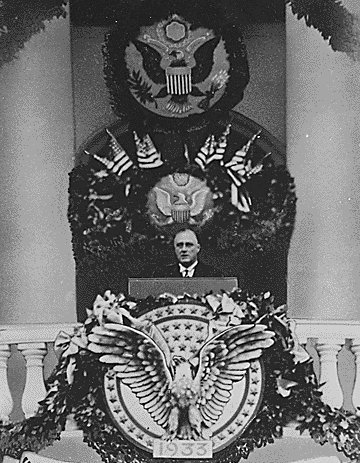
FDR's famous quote in his inaugural address "We have nothing to fear but fear itself" says a lot about this time period of doubt and economic turmoil. People were afraid for their jobs, afraid that they might be thrown out on the streets, afraid that their savings might disappear if their bank failed. All of the stuff that they had believed in about the American Dream - work hard, save money, follow the rules and you'll be rewarded - was crumbling before their eyes.

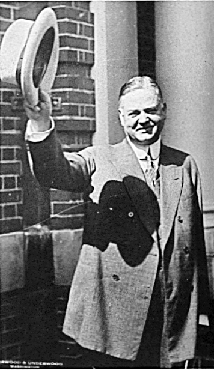
During Herbert Hoover's administration, however, President Hoover tried to reassure the nation that the economy was basically sound and that Americans needed to follow the example set by many of rugged individualism. This concept was widely accepted before the turn of the 20th century when Hoover grew up - the idea that life is a race; "[Americans] give [everyone] an equal start; we provide in the government the umpire of fairness in the race. The winner is he who shows the most conscientious training, the greatest ability, and the greatest chracter" (Hofstadter 387). Hoover followed this creed as did thousands others who became rich in the time before the Depression. The problem was, millions became poor and showed that the race was far from equal or fair. Those with the greatest ability or character did not always win.

Before you answer the question below, click on the link for Journal #2 and read the article about rich and poor in today's society. http://news.yahoo.com/s/afp/20070122/lf_afp/useconomysocialwealth

My questions for you are this:
1. Is life like a race and those who are the strongest, smartest, etc. win the race? If so, explain. If not, explain your alternative.
2. Do you think life in America is fair? Why or why not?

Please don't forget to leave your name on your comment. Thanks.

Tuesday, January 16, 2007

Journal #1 - James Baldwin quote


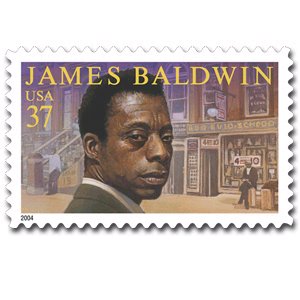
Great American writer James Baldwin wrote this about American history:

"American history is longer, larger, more various, more beautiful, and more terrible than anything anyone has ever said about it."

Question: What do you think he means by this quote (besides restating the obvious -"American history is longer, more beautiful...etc. ")? Use an example from first semester American history (or one that you're familiar with) that best captures this quote and explain why your incident/person/event applies to the quote. (minimum 200 words)

Things to think about when writing your response: try to go in depth by thinking about what has been taught or hasn't been taught about American minorities in the past. Consider how future Americans (your children and grandchildren) will look at today's history. What have you studied in the past that has really struck a nerve? Why?

Citation: James Baldwin (1924–1987), U.S. author. “A Talk To Teachers,” October 16, 1963, published in The Price of the Ticket (1985).

Wednesday, January 03, 2007

Journal #9 - The Scopes Trial - One of the Trials of the Century

The Scopes Trial in Dayton, Tennessee was labeled the "Trial of the Century" when it occurred in July 1925. Editors across the country called it thus b/c the case represented so much of what was going on in the 1920s:
1. Old vs. New
2. Rural vs. Urban
3. God vs. Science
4. Faith vs. Reason
5. Traditional values vs. city morals

Celebrity lawyers Clarence Darrow and William Jennings Bryan battled for eleven days with very different intentions: Darrow wanted to put the Butler Act (Tennessee's state law banning the teaching of evolution) on trial while Bryan sought to rid the world of Darwinian thought seeing World War 1 and Social Darwinism as its end result). Scopes was eventually found guilty, fined $100 (which both the ACLU and Bryan offered to pay for him). Unfortunately, five days after the trial, Bryan died in Dayton.


In 1926, Mississippi becomes the 2nd state to outlaw the teaching of evolution. The next year, the Tennessee state Supreme Court affirms the Butler Act but overturns Scopes conviction on a technicality. 1928, Arkansas becomes the 3rd state to ban evolution.

Eventually, Tennessee would repeal the Butler Act in 1967 but pass a law in 1973 that requires science teachers to give equal time to creation as a competing theory to the origin of man. In 1968, 1982, and 1987, the U.S. Supreme Court declares these laws banning evolution (or requiring creation to be taught) as unconstitutional. It seemed that by 1987, the debate was over.

But, it's not. According to the article I handed out, "Monkey See, Monkey Do", Intelligent Design (ID) has taken the place of creation in classrooms and school board meetings around the country. There is even a think tank university dedicated to promoting ID teaching in public schools. President Bush thinks ID should be presented as a competing theory. The only problem with ID is that there is no scientific basis for it.

A school district in Dover, Penn. was recently prohibited by a judge from teaching ID in its biology classes, and the three school board members who pushed for its inclusion in the high school curriculum were recently ousted from the board after national embarassment. See the CNN link for this case: http://www.cnn.com/2005/LAW/12/20/intelligent.design/index.html

So my question is two fold:
1. Does the teaching of creation / Intelligent Design in public schools cross the line when it comes to separation of church and state (where the government should not endorse or favor one religion -in this case the Judeo-Christian religion - over another) as specified in the 1st Amendment? Why or why not?
2. Should creation / ID be presented as a competing theory for the origin of man along with evolution in public schools? And why in the world hasn't this controversy gone away even 81 years after the Scopes Trial?

Great timeline on the Scopes Trial and Creation / Evolution controversy: http://www.npr.org/templates/story/story.php?storyId=4723956

Thursday, December 14, 2006

Extra Credit Opportunity

I am offering an opportunity for extra credit.

You can do a movie review of a movie made about a subject that we have studied so far. You will be responsible for giving me the following:
1. A minimum one-page summary of the movie's plot/story including a description of the main characters.
2. Minimum 1/2 page summary of the historical elements in the movie - what historical events, people, or moments in time does this movie portray? Are these characters real, fictional? Describe the clothes, transportation, technology (yes, they do have their own version of technology - it's just Outdoor Plumbing 1.0), historical attitudes and beliefs, etc. Provide at least four specific examples with explanation.
3. Minimum 1/2 page on how this movie has expanded your historical awareness of the topic we have already studied. Make sure you describe in this section how the movie connects with an era that we have studied with specific examples from the movie.
4. Keep It or Ditch It - This is where you rate the movie on a true teenager's interest scale. After watching this movie, would this movie might have been something you would have picked out on your own to watch? Why or why not? For a school-related history movie, on a scale of one to five (one being "Good God, don't ever show that again!" to five being "I'm getting on Amazon to buy the DVD"), give a rating for the movie with an explanation.

The assignment is worth 20 points max. Pick from the movies below.

Sommersby (1993) - Richard Gere and Jodie Foster - Reconstruction romance
Path of Glory (1957) - Kirk Douglas - World War 1
Eight Men Out (1988) - John Cusack, Charlie Sheen - Chicago White Sox Scandal
In Love and War (1996) - Chris O'Donnell and Sandra Bullock - The story of Ernest Hemingway and nurse Agnes von Kurowsky
Iron Jawed Angels
Gettysburg - (1993) - details the story of the battle of Gettysburg over the course of 4 hours
Gods and Generals (2003) - Follows the stories of Generals Lee and Stonewall Jackson between 1861-1863 of the Civil War.
The Molly Maguires (1970) - Irish immigrants and their story of the coal mines in Pennsylvania in 1876
Dances With Wolves (1990) - Kevin Costner. Mary Mcdonell, Graham Greene - Civil War soldier makes friends with Sioux tribe, but then has to choose.
Wyatt Earp (1994) - Kevin Costner, Dennis Quaid, Gene Hackman - cowboys out West and the true story of Wyatt Earp
I Will Fight No More Forever (1971) - Sam Elliot and Ned Romero - Chief Joseph's Nez Perce tribe
Andersonville (1996) - made for TV movie (TNT) about Confederate Civil War prison camp
Inherit the Wind (1960) - The Scopes trial
Far and Away (1992) - Tom Cruise and Nicole Kidman - Irish immigrants come to America
Matewan (1987) - Chris Cooper - Profiles the attempt to unionize the coal mines in West Virginia and the violence that followed.


In order to receive credit for this assignment, you must upload your assignment at www.mydropbox.com. When you first get to the website, type in the following info in the light blue boxes at the top of the webpage: Login is 62629 and the password is wickersham (all lower case). Then you will get to a Submit Your Paper page. Click the pull down menu to movie review (if that's what you've done), type in your email, your name, document title (put the movie title in it), and then either cut and paste or upload your paper from a file.

As a warning, this site will cross reference your paper with many websites on the internet and the other kids who have done this assignment in both of my classes. Two suggestions: 1. Do your own work in your own words; and 2. Don't share your work with anyone no matter who it is. You never know who they'll share it with.

Wednesday, December 13, 2006

Journal #8 - Freedom of the Press vs. Wartime Government

I bring up the dual issues of censorship of ideas and censorship of the press during wartime because it came up during the talk on the Espionage and Sedition Acts during the Great War. Under these acts, a person can be fined up to a max of $10 grand and given a 20 year sentence for interfering with the sale of war bonds or the draft, or saying anything profane, disloyal, or abusive about the government. Obviously, these laws violate the 1st Amendment.

During wartime, there is a feeling that certain ideas may be considered dangerous, traitorous, or even downright unpatriotic. Many have been accused of such things when criticizing their government during times of war, and our history book mentions some of them. Eugene V. Debs, a Socialist Party leader and candidate for the Presidency, was sentenced to ten years in prison and fined $10,000 for "speaking out against the war and the draft" (Danzer, et. al. 392). Anarchist Emma Goldman was convicted and sentenced for creating a No Conscription League and then was deported to Russia after two years in jail.

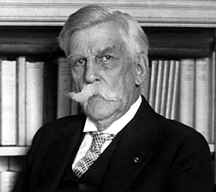
The legal reasoning backing these cases up was set in cases like Schenck v. U.S. (1919). Eminent justice Oliver Wendell Holmes jr. stated that "the question in every case is whether the words used are used in such circumstances and are of such a nature as to create a clear and present danger that they will bring about the evils that Congress has a right to prevent." Justice Holmes went on comparing protecting free speech of the guy who yells "FIRE!" in a crowded movie theatre. Holmes implied that Mr. Schenck's wartime leaflets were that kind of clear and present danger and therefore needed to be censured. Is Justice Holmes correct when he compares the two? Or should there be freedom of expression even during times of war?

Then there's the case of the press. Should the press have access to everything as if there wasn't a war going on? What if the war had secret information? Should they publish or release the info to the public? How much censorship is too much? How much is too little?

You can pick either freedom of the press or freedom of speech, or feel free to tackle both issues. Use a specific example if you'd like. All submissions should be a minimum of 150 words (that's for you, Joe!).

Monday, December 04, 2006

Journal #7 - Can we learn from the lessons of past imperialism?

During our look at the Spanish American War and the Filipino-American War, I tried to draw some obvious parallels between the Persian Gulf War (1990-91) and the Iraq War (2003 - present) . Hasty, short wars like the Spanish American War and the Persian Gulf War were thought to be the wars of the future: short and relatively bloodless using the latest in technology. Then there's the Filipino-American War and the Iraq War: two wars fought to quell insurgencies (though intitially Iraq was about toppling Saddam). Both wars have proven to be brutal, divisive at home, and required our soldiers to do some wicked things in order to win.

Here's a quote from the Philadelphia Ledger in 1901 about the war in the Philippines:
"Our present war is no bloodless, fake...engagement. Our men have been relentless: have killed to exterminate men, women, children, prisoners and captives, active insurgents and suspected people, from lads of ten on up, an idea prevailing that the Filipino, as such, was little better than a dog, noisome reptile in some instances, whose best disposition was the rubbish heap. Our soldiers have pumped salt water into men to "make them talk," have taken prisoner people who held up their hands and peacefully surrendered, and an hour later, without an atom of evidence that they were even insurrectos, stood them on a bridge and shot them down one by one, to drop into the water below and float down as an example to those who found their bullet-ridden corpses."

Taking into account the stuff we've learned in our imperialism unit and in the imperialism debate, what kinds of lessons can we learn from American imperialism? Any one of these questions could apply for your journal.
- Is it worth the economic security to control the destinies of countries we can barely identify on the map?
- Are we sacrificing our democratic ideals when we take over other countries and pick their rulers for them? Why or why not?
- If we continue to worry about and depend upon oil in the Middle East, how will we ever develop clean energy sources that will get us off of our dependency?
- Is our dependency upon Middle East oil a security threat? Why or why not?
- When we are $8.659 trillion in the hole, how can we afford to be everywhere around the world?


Pick a question or come up with another angle on how we can learn from our past history of over 100 years of imperialism.

Editor's Note: We didn't amass this monstrous $8.659 trillion dollar debt just on Iraq alone. It started in 1969 when we were fighting the War on Poverty and the War in Vietnam at the same time. Then, we started outspending the Soviet Union during the 1980s to win the Cold War. That didn't happen until 1991. After 1991, our government was huge and wasteful, but still provided essential services. President Clinton signed a huge tax package to begin chipping away at the national debt in 1993, and by 1999, taxes along with a booming economy helped the government start to slowly pay down some of the debt. That all changed w/ President G.W. Bush.

Plus, there is security to think about when America acts as we do. Are we acting in our own best interests for vital resources, strategic locations, and the security of the nation?

- G.W., your devil's advocate!

Sunday, November 19, 2006

Journal #6 - Evaluation of Teddy Roosevelt's presidency

Teddy Roosevelt was president for almost 8 full years between 1901-1909, and he ran for a 3rd term in 1912. That election ended up with Woodrow Wilson winning with the Republican votes divided between Taft and Roosevelt. This win for Wilson seemed to signal an end to TR's career.

During his presidency, TR felt that muckraking journalists were a danger to democracy b/c they riled up anti-government or anti-American feelings when they exposed government and business corruption. People like himself (educated, informed, those with good intentions) are the ones who should be controlling reform. Reform is better than revolution, TR believed.

These muckrakers were extremely pivotal in bringing about changes in monopolistic businesses (Standard Oil), changes in the meat and medicine industries, and in poverty and local and state government corruption. Yet, TR felt that he was the best of both worlds - reform but not radical reform.

So, my question for you is: who is right, TR or the muckrakers? Should the president lead reform or should it be the journalists? Or, do you think there should be someone else being at the forefront of business and government? Congress? Consumers? Explain your answer (in a minimum of 150 words).

Thursday, November 09, 2006

Journal #5 - Eugenics and Social Darwinism

During this unit on immigration and the growth in American cities, we looked a lot and discussed issues concerning the poor in America, both back then and now. Social Darwinism was used as a philosophy to justify the inequality between rich and poor before the 20th Century, and denying charity or help of any kind to the poor was seen as interference w/ natural law.

Eugenics became popular enough so that over 30 states had eugenics / sterilization laws on the books by 1935. According to some of the research out there, 70,000 Americans were involuntarily sterilized by 1970 for reasons like laziness, promiscuity, mental "deficencies", and the like. This way, the poor could not pass on their bad genes to their children thereby making more children. The thinking went, fewer poor people now = fewer poor children in the future.

But who gets to decide who is fit to have children and who isn't fit?

Tell me your reactions to our discussion this week about social Darwinism, eugenics, the poor, and the articles you were given. (Minimum 150 words reply please).

Feel free to discuss or react to other comments posted by students on the blog.